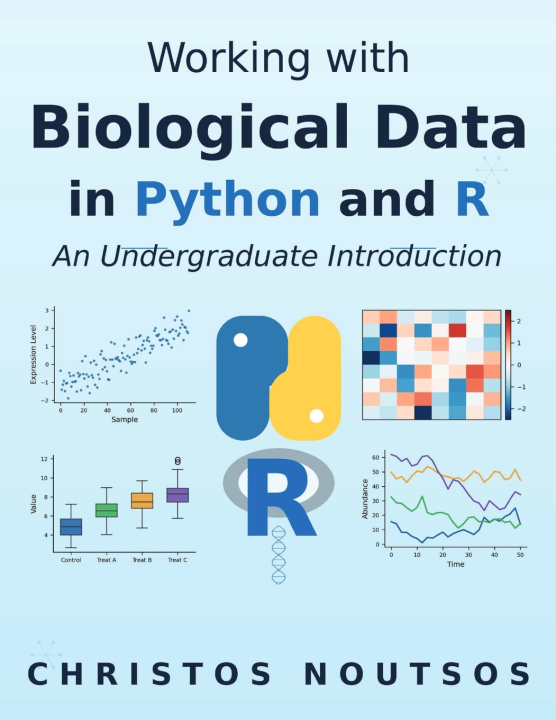
Learn to analyze biological data in both Python and R-even if you have never written a line of code.
Modern biology runs on data. Whether you are sequencing genomes, surveying ecosystems, or measuring gene expression, turning messy spreadsheets into clear answers is now as essential a lab skill as the pipette. Working with Biological Data in Python and R is the hands-on, beginner-friendly introduction written specifically for biology students and researchers.
This is the rare bioinformatics textbook that teaches Python and R side by side, so you learn each idea once and immediately see it done in both languages. Every chapter is built on real biological examples-fish, plants, microbes, genes, and DNA-with simulated datasets, ready-to-run scripts, and exercises so you practice as you read. No prior programming or statistics experience is required.
Across 20 approachable chapters you will learn to:
- Set up your computer and write your first scripts in Python and R
- Read, clean, and explore messy real-world data with pandas and the tidyverse
- Build clear, publication-quality data visualization with ggplot2, matplotlib, and seaborn
- Apply core biostatistics-comparing groups, correlation, and regression-and sidestep the most common mistakes
- Work with DNA and protein sequences in Biopython, plus genome annotation and key file formats (FASTA, FASTQ, VCF)
- Run a complete RNA-seq differential expression analysis with DESeq2 and interpret the results
- Measure biodiversity with vegan and scikit-bio, and read phylogenetic trees with ape and ete3
- Take your first steps in machine learning for biology with scikit-learn
- Make your work reproducible with notebooks, Git, and GitHub
By the end you will not just follow recipes-you will be able to ask your own biological questions and answer them with data.
Ideal as an undergraduate bioinformatics and biostatistics textbook, a self-study guide for life scientists, or a practical desk reference for anyone making the leap into computational biology and data analysis. Clear explanations, fully worked dual-language code, and real datasets make it the friendliest on-ramp to coding in the life sciences.
Open the book, open your data, and start coding today.