Introduction: Species Overview
Identity of the Wood Bison
The wood bison stands as one of North America's most powerful and ancient land mammals, a distinct subspecies of the American bison revered for its immense physical presence, quiet intelligence, and centuries-deep connection to northern landscapes. Unlike its more widely recognized relative-the plains bison-the wood bison carries a deeper history carved into the forests and meadows of Canada and Alaska, where ice, isolation, and seasonal extremes shaped it into the world's largest land animal in the Western Hemisphere. Its identity is rooted not only in size but in a suite of traits that evolved from surviving long winters, navigating dense boreal ecosystems, and moving in herds that once stretched farther than the eye could see.
Understanding the wood bison requires understanding the land that formed it: a place where survival meant moving with the rhythms of the forest, grazing between shifting seasons, and developing a physiology capable of conserving energy under deep snow and bitter temperatures. This subspecies carries a story of both endurance and near-extinction, a testament to how nature shapes life while human influence can either destroy or revive it. The wood bison remains recognizable not only for its massive frame but also for its timeless calm, measured movement, and a natural dignity that reflects thousands of years of adaptation.
Defining Traits That Distinguish the Wood Bison
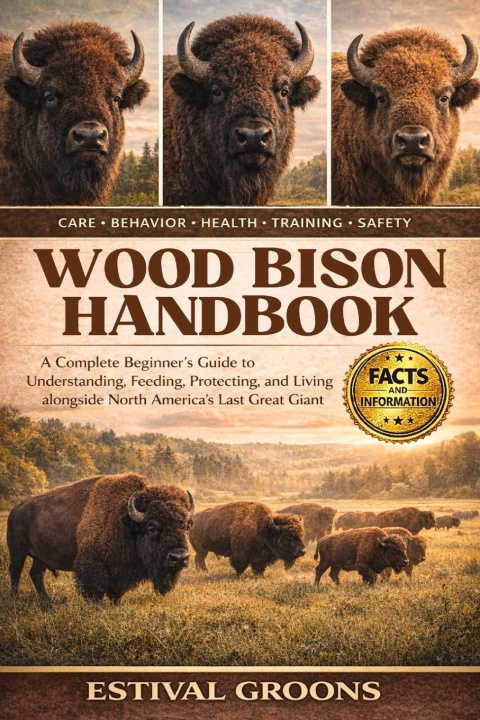
The wood bison is more than a larger version of the plains bison-it is a uniquely sculpted animal with characteristics fine-tuned to boreal forests. Its hump is higher, sharper, and more pronounced, giving it a towering silhouette when viewed from a distance. Its head slopes downward more steeply, allowing it to push through deep snow or forage beneath winter layers where grasses and sedges lie dormant. The horns curve upward with more length and separation, creating a more formidable appearance while supporting defensive behavior within herds.
The coat of the wood bison is another hallmark trait. Longer, shaggier, and more insulated, it acts as a shield against harsh winter winds. The forequarters are heavily muscled, allowing the animal to swing its head and shoulders through packed snow to uncover vegetation vital to survival. These features are not random-they are the result of thousands of years spent living in northern environments where food scarcity and cold shaped every aspect of morphology.
Several characteristics stand out:
- Mass and stature: Wood bison bulls commonly exceed 900 kg, and exceptional individuals may approach or surpass 1,100 kg, making them the heaviest surviving land mammals in North America.
- Herd structure: Their groups tend to be more dispersed than plains bison herds, adapting to the broader availability of forage in forest openings.
- Energy-efficient movement: Their gait and feeding patterns reflect an evolutionary drive to conserve strength through long winters.
These traits, collectively, create a bison built for survival where lesser-adapted herbivores would struggle. The wood bison is not simply a creature of strength; it is a specialist shaped by its environment.
The Deep History of the Wood Bison
The story of wood bison stretches back to the late Pleistocene era, when enormous herds roamed across broad northern territories. Fossil evidence shows that their ancestors navigated glacial margins and open woodland ecosystems long before humans arrived on the continent. The species evolved through cycles of climatic change, surviving periods when ice sheets advanced and retreated, reshaping the land each time. As the northern environment shifted, so did the bison, adapting to new plant communities, migratory routes, and predation pressures.