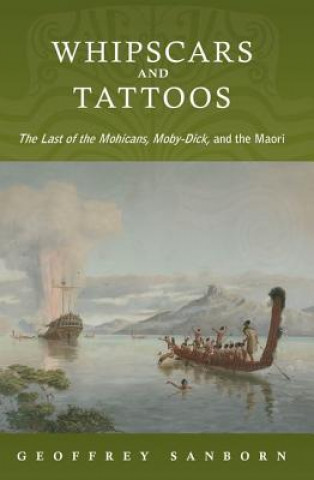
Carte Whipscars and Tattoos Geoffrey Sanborn

Whipscars and Tattoos

The Last of the Mohicans, Moby-Dick, and the Maori

Limbă: engleză
Legare: Carte broșată
Disponibilitate: În depozitul extern
Expediem în 10-18 zile
171.06 lei
In this original study, Geoffrey Sanborn presents a fresh interpretation of the villanous Magua in J...

Informații despre carte

Limbă
engleză
Legare
Carte - Carte broșată
Publicat
2013
Pagini
208
EAN
9780199985760
ISBN
0199985766
Enbook ID
04537181
Greutate
276
Dimensiuni
216 x 217 x 16

Descriere completă

In this original study, Geoffrey Sanborn presents a fresh interpretation of the villanous Magua in James Fenimore Cooper's The Last of the Mohicans (1826) and of the dignified harpooner Queequeg in Herman Melville's Moby-Dick (1851). Through careful historical research, Sanborn has determined that both authors relied heavily on contemporary accounts of the indigenous natives of New Zealand, the Maori, to develop their iconic characters. Cooper drew heavily on the account of Te Aara in John Liddiard Nicholas's Narrative of a Voyage to New Zealand (1817) while Melville studied the personal history of Te Pehi Kupe in George Lillie Craik's The New Zealanders (1830) to flesh out his characterization of Queequeg. A close reading of the historical evidence and the source material supports this compelling line of argumentation. At the same time, this isn't a simple source study nor an act of explanatory historical recovery. The conception of the Maori is sophisticated and paradoxical, a portrait of violent but nonetheless idealized masculinity in which dignity depends on the existence of fiercely defiant pride. This lens allows Sanborn to present a radically different view of these fictional characters as well as underscoring the imaginative projection that went into reporting on the Maori themselves. Magua is no longer a stereotypical "bad Indian" or "ignoble savage," but rather a non-white "gentleman," an argument that supports Sanborn's contention that throughout his career Cooper prioritizes status equivalence over racial difference. Queequeg is similarly re-imagined, a move that allows Sanborn to explicate scenes in Moby-Dick that are often dodged by other critics because they do not fit with the standard interpretations of the character. The study as a whole provides a vivid example of the fascinating interplay between fiction and non-fiction in the nineteenth century.

S-ar putea să te intereseze

Slam Dunk, Vol. 4

Takehiko Inoue
55.44 lei

Seams of Empire

Carlos Alamo-Pastrana
176.58 lei
116.51 lei

Paul Ricard

Robert Murphy
131.98 lei
78.84 lei
106.87 lei
589.44 lei
203.30 lei

Carry Home

Gary Ferguson
78.84 lei
878.14 lei

Phoenix

Roderick Stewart
205.21 lei
217.57 lei

Cave Baby

Julia Donaldson
52.73 lei

After the Last Sky

Edward W. Said
185.52 lei
254.74 lei

Clienții care au cumpărat această carte au mai cumpărat și

Characters on the road

Mustafa El-Feki
100.24 lei

Epikur

Florian Russi
35.35 lei

Autopologia

Villabianca
45.39 lei

Poznaje swiat zmyslami

Opracowanie zbiorowe
42.68 lei

Europa Und Seine Werte

Jerzy Bartminski
484.87 lei
36.86 lei