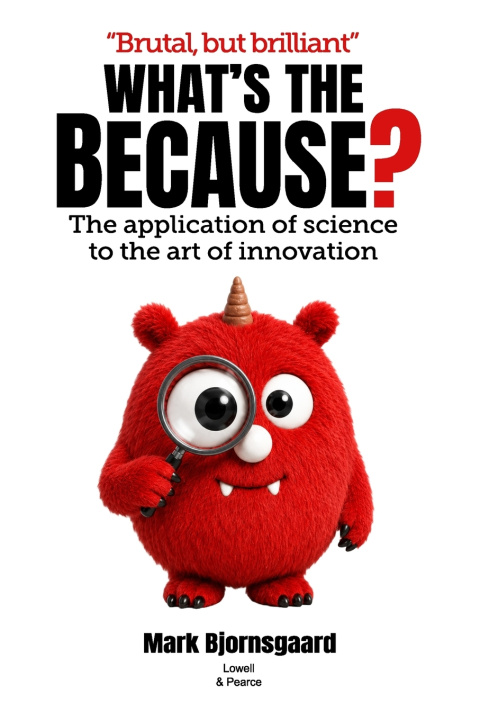
What's the Because?
Innovation is not failing because we lack ideas.
It is failing because we have too many of them.
Every year, founders, product teams and corporate innovation departments burn vast amounts of time, money and energy building things people do not want. Not because they are stupid. Not because they lack ambition. Because they start in the wrong place.
They start with ideas.
Ideas arrive fast. They feel clever. They give teams something to rally around, pitch, fund and build. They flatter the people who have them. They create momentum. They look like progress.
But ideas are usually solutions wearing a convincing disguise.
Once we fall in love with them, we stop asking the only question that matters:
What customer need are we actually solving?
For centuries, humans have had one reliable process for finding truth in conditions of extreme uncertainty: the scientific method.
Start with a question.
Isolate the variables.
Follow the data.
This method built the modern world. It gave us medicine, engineering, aviation, computing, space travel and almost every serious advance humans have made in the face of the unknown.
Innovation should be its natural home.
New products, new markets and new ventures are all exercises in uncertainty. At the beginning, nobody knows what customers will value, what behaviour will change, what people will pay for or which assumptions will survive contact with reality.
And yet entrepreneurship mostly does the opposite.
We start with a solution, call it strategy, wrap it in a deck and hope the market agrees.
It usually doesn't.
What's the Because? is a practical manual for making innovation more scientific, more disciplined and much harder to fool.
First, it shows why our brains love ideas, and why that love quietly sabotages us. Ideas are not useless. They are part of how humans move quickly through the world. We are programmed to generate them, love them and act on them. That is exactly why they are so dangerous in innovation. They feel true long before they have earned the right to be believed.
Then the book shows you how to start somewhere better: customer need. It teaches you how to move from vague conviction to sharper hypotheses, from pitch-deck confidence to evidence, from "we think this is a great idea" to "we know what we are trying to learn."
This is not innovation theatre. It is not a brainstorm. It is not another canvas, framework or workshop designed to make everyone feel aligned while nothing meaningful changes.
It is a way of forcing discipline into the messy early stages of building something new.
Finally, What's the Because? turns to the organisation itself. Because even strong evidence can die inside companies that are not ready to receive it. Corporate innovation too often collapses into politics, governance, PowerPoint, brand anxiety, legal caution and well-funded theatre. The book shows how a scientific way of working can survive inside real businesses, where risk, ego and bureaucracy usually drag innovation back into the old habits.
This is a book for founders who do not want to waste years building the wrong thing.
It is for product teams who are tired of shipping features nobody uses.
It is for corporate leaders who suspect their innovation function has become a machine for producing decks instead of evidence.
And it is for anyone who believes entrepreneurship should be less mystical, less wasteful and more honest.
The promise is simple.
Start with customer need. Test what matters. Follow the data. Kill what does not work. Build what does.
The result is a faster, cleaner and more repeatable way to discover what people actually want - before you waste your life building what they don't.