Carte Weak Island Semantics Marta Abrusan

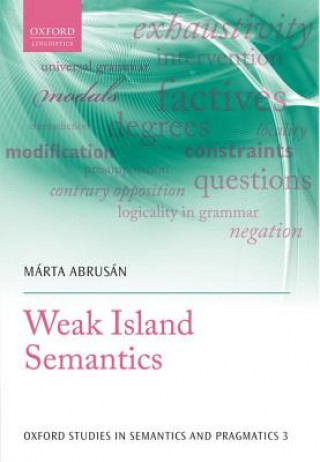
Weak Island Semantics

Autor: Marta Abrusan
Limbă: engleză
Legare: Copertă tare
Disponibilitate: În depozitul extern
Expediem în 10-18 zile
968.29 lei
This book presents a novel semantic account of weak, or selective, islands. Weak islands are configu...


Informații despre carte

Limbă
engleză
Legare
Carte - Copertă tare
Publicat
2014
Pagini
260
EAN
9780199639380
ISBN
0199639388
Enbook ID
04534218
Greutate
636
Dimensiuni
194 x 259 x 24

Descriere completă

This book presents a novel semantic account of weak, or selective, islands. Weak islands are configurations that block the displacement of certain elements in a sentence. Examples of island violations with acceptable counterexamples include '#How much wine haven't you drunk?' (but 'Which girl haven't you introduced to Mary?'), '#How does John regret that he danced at the party?' (but 'Who does John regret that he invited to the party?') or '#How much wine do you know whether you will produce?' (but 'Which glass of wine do you know whether you'll poison?'). For forty years or more, explanations of the unacceptability of these island constructions have been syntactic. Syntactic accounts have also provided some of the key empirical motivation for Chomsky's claim that universal grammar (UG) contains language independent abstract syntactic constraints. But syntactic accounts, however subtle, fail to explain why many weak island violations are made almost acceptable by modals and attitude verbs, as in 'How much wine aren't you allowed to drink?'; 'How fast do you hope Lewis didn't drive?'; or 'How does Romeo regret he was allowed to go to the party?' Dr Abrusan considers which contexts and expressions create - or are sensitive to - weak island violations, and examines the factors that go some way to curing them. She puts forward a semantic analysis to account for the unacceptability of violations of negative, presuppositional, quantificational and wh-islands. She explains why grammaticality violations can be obviated by certain modal expressions, and why and how far the grammaticality judgments of speakers depend on the context of the utterance. The book argues that there is no need to assume abstract syntactic rules in order to derive these facts; rather, they can be made to follow from independent semantic principles. If correct, this work has a fundamental consequence for the field of linguistics in general: it removes some of the most important reasons for postulating abstract syntactic rules as part of UG, and hence weakens the arguments for postulating a module of UG.

S-ar putea să te intereseze

PERFECT IDEA

MILLER ARNA
85.44 lei

The Yellow Wallpaper

Charlotte Perkins Gilman
40.84 lei

Final War

Kerry D Lewis
103.34 lei

Gender and Rhetoric in Plato's Political Thought

Michael S. (Tel-Aviv University) Kochin
653.07 lei

Idea of Cuba

Alex Harris
190.82 lei

Joan of Arc

Regine Pernoud
79.37 lei

Human Constitution

Richard J. Regan
115.17 lei
115.38 lei
2 356.77 lei

Clienții care au cumpărat această carte au mai cumpărat și

Smaragdové město

Šárka Bubíková
10.51 lei
55.21 lei
106.38 lei

Aus dem Leben eines Taugenichts

Joseph Freiherr Von Eichendorff
288.10 lei
79.78 lei
45.70 lei
52.88 lei