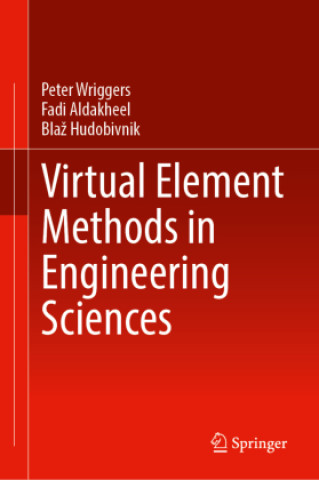
Carte Virtual Element Methods in Engineering Sciences Peter Wriggers

Virtual Element Methods in Engineering Sciences

Limbă: engleză
Legare: Copertă tare
Editura: Springer, Berlin
Disponibilitate: În depozitul extern
Expediem în 10-13 zile
990.92 lei
This book provides a comprehensive treatment of the virtual element method (VEM) for engineering app...


Informații despre carte

Limbă
engleză
Legare
Carte - Copertă tare
Publicat
2023
Pagini
468
EAN
9783031392542
Enbook ID
43703835
Greutate
948
Dimensiuni
155 x 235

Descriere completă

This book provides a comprehensive treatment of the virtual element method (VEM) for engineering applications, focusing on its application in solid mechanics. Starting with a continuum mechanics background, the book establishes the necessary foundation for understanding the subsequent chapters. It then delves into the VEM's Ansatz functions and projection techniques, both for solids and the Poisson equation, which are fundamental to the method. The book explores the virtual element formulation for elasticity problems, offering insights into its advantages and capabilities. Moving beyond elasticity, the VEM is extended to problems in dynamics, enabling the analysis of dynamic systems with accuracy and efficiency. The book also covers the virtual element formulation for finite plasticity, providing a framework for simulating the behavior of materials undergoing plastic deformation. Furthermore, the VEM is applied to thermo-mechanical problems, where it allows for the investigation of coupled thermal and mechanical effects. The book dedicates a significant portion to the virtual elements for fracture processes, presenting techniques to model and analyze fractures in engineering structures. It also addresses contact problems, showcasing the VEM's effectiveness in dealing with contact phenomena. The virtual element method's versatility is further demonstrated through its application in homogenization, offering a means to understand the effective behavior of composite materials and heterogeneous structures. Finally, the book concludes with the virtual elements for beams and plates, exploring their application in these specific structural elements. Throughout the book, the authors emphasize the advantages of the virtual element method over traditional finite element discretization schemes, highlighting its accuracy, flexibility, and computational efficiency in various engineering contexts.

S-ar putea să te intereseze

30.82 lei

Clienții care au cumpărat această carte au mai cumpărat și

Karlinchen

Annegert Fuchshuber
68.81 lei

Hobelbänke

Christopher Schwarz
201.80 lei