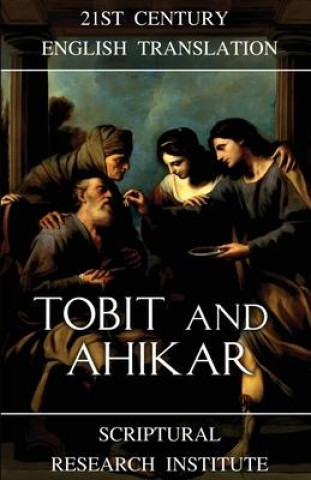
The Words of Ahikar is the oldest surviving Israelite story, with known copies in Aramaic dating back to the 5th century BC, making it a couple of centuries older than the oldest of the Dead Sea Scrolls. While the story is set during the Assyrian Captivity of the Samaritans during the 7th century BC, it is generally accepted by scholars that the book was written in its current form in the 6th century BC, during the Babylonian Captivity of the Judahites.
It does not appear to have been considered a religious book by Judahites under Greek rule, or later when Judea became independent and was not included in either the Septuagint or the Masoretic Text. Nevertheless, the author of the Book of Tobit, which is in the Septuagint, clearly viewed the Words of Ahikar as authentic, as his protagonist Tobit claimed that he was Ahikar's uncle, and both Ahikar and his nephew Nadan make a brief appearance in the book of Tobit at Tobit's son Tobiah's marriage feast in Nineveh. The Book of Tobit was likely written in the Median Empire and carried into Judea by the priest Tobiah, who was listed as one of the leaders of the Israelites who returned to Judea after Cyrus II (the Great) released the Judahites when he conquered Babylon.
The version of the book of Tobit found in the Codex Vaticanus and most surviving copies of the Septuagint was translated into Greek from Aramaic and added to the Septuagint, likely before 200 BC when the Judean Revolt against the Ptolemys rule, resulting in most Jews and Samaritans fleeing from Egypt, either east into Judea, or south into Nubia. There is another version of the Book of Tobit found in the Codex Sinaiticus, which appears to be older than the version in the other codices, and not translated in the Ptolemy's Egypt, but somewhere in the Seleucid's Empire.
The Book of Tobit is generally viewed as fiction by most scholars for a variety of reasons. One major reason it is viewed as fiction is the presence of Tobit's cousin Ahikar, in both versions of the book, who is the protagonist of the Words of Ahikar, a book set in the same era, which is also considered fiction. It is quite clear from the text of Tobit, that it is the same Ahikar, and not just someone with the same name, as Ahikar's betrayal by his nephew is mentioned, which is part of the early section of Ahikar. Nevertheless, both books, Tobit and Ahikar survive in various forms, meaning that they were edited multiple times before the versions that survive to the present were transcribed. The surviving copies of the Septuagint include two versions of the Book of Tobit, the more common form, found in the Codex Vaticanus, Codex Alexandrinus, and most other surviving copies of the Septuagint, and the less common version found in the Codex Sinaiticus. Additionally, fragments of Tobit found among the Oxyrhynchus Papyri don't match either the Vaticanus or Sinaiticus version of Tobit. The Oxyrhynchus Papyri are a collection of ancient texts found in southern Egypt dating to the Greek, Roman, and Byzantine eras of Egyptian history, approximately 300 BC to 640 AD. Among the Oxyrhynchus Papyri, two fragments of Tobit have been found, Papyrus 1594, dated to circa 275 AD, and Papyrus 1076, dated to circa 550 AD. Unfortunately, these fragments are extremely short, with only a few lines surviving from chapters 12 and 2 respectively. The Oxyrhynchus Papyri fragments of Tobit are in Greek but do not match surviving versions found in the Septuagint codices, meaning there were no less than three Greek versions of Tobit in circulation by 350 AD when the Codex Vaticanus and Codex Sinaiticus are dated to.