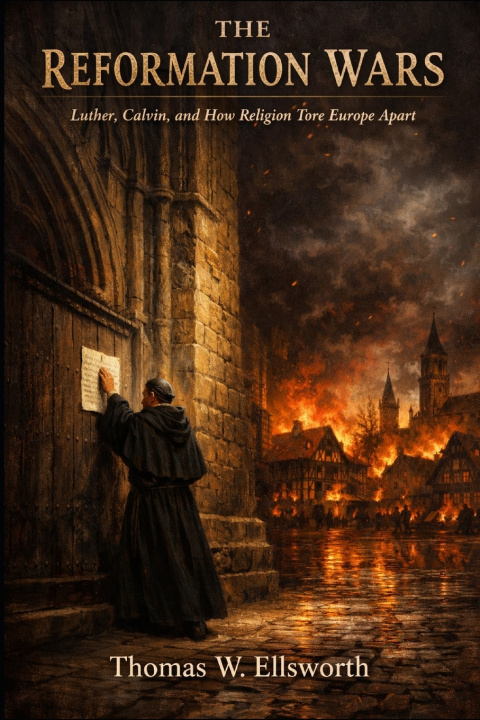
On October 31, 1517, a German monk pressed a sheet of parchment against a church door. Within thirty years, Europe was burning.
This is not a book about theology. It is a book about what happens when the most powerful institution in the world is told it is wrong, refuses to listen, and watches the consequences spiral far beyond anyone's ability to control. It is about a continent that believed, with complete sincerity, that it was fighting over the fate of immortal souls, and tore itself to pieces in the process.
The Reformation Wars follows the full arc of the greatest catastrophe in European history before the twentieth century, beginning with the world that made Martin Luther and ending at the Peace of Westphalia in 1648, where exhausted diplomats signed documents acknowledging that Christendom had broken permanently in two and would never be reassembled. In between lies a century of religious revolution, political betrayal, military devastation, and individual courage that reshaped every assumption Western civilization had about God, government, conscience, and the limits of power.
You will stand in the thunderstorm with the terrified law student who made a vow he could not take back. You will follow him to Rome, where he watched priests race through sacred rituals with the boredom of men doing a job, and felt the first cold crack in his faith in the institution he had given his life to serve. You will be in the hall at Worms when he faced the most powerful ruler in the world and refused to be silent.
You will watch John Calvin transform a second-rate Swiss city into the nerve center of an international revolution, govern it with the precision of a man who believed every detail of daily life was answerable to God, and then order a man burned at the stake for disagreeing with him about the Trinity.
You will sit in the barn at Vassy on the morning of March 1, 1562, when the soldiers arrived. You will walk through the streets of Paris on St. Bartholomew's Day, August 24, 1572, when the bells rang and between five thousand and thirty thousand people died in the following weeks. You will follow the German shoemaker who chronicled his family's flight, again and again, from the armies that consumed everything they touched during thirty years of war that reduced entire provinces to a fraction of their former populations.
This is history written the way history actually happened: not as the orderly procession of ideas and institutions that textbooks describe, but as a series of irreversible human decisions made under pressure, in fear, in faith, and sometimes in cold calculation, by people who could not see where their choices were leading.
The world you live in now, with its fragmented religious landscape, its assumptions about individual conscience and state sovereignty, its print culture and its tolerance of disagreement, carries the direct imprint of what happened between 1517 and 1648. Understanding how that world was built, at what cost and by whose hands, is not a luxury for specialists. It is one of the essential stories of how modernity was made.
The fire started with a sheet of parchment. The Reformation Wars tells you everything that happened next.