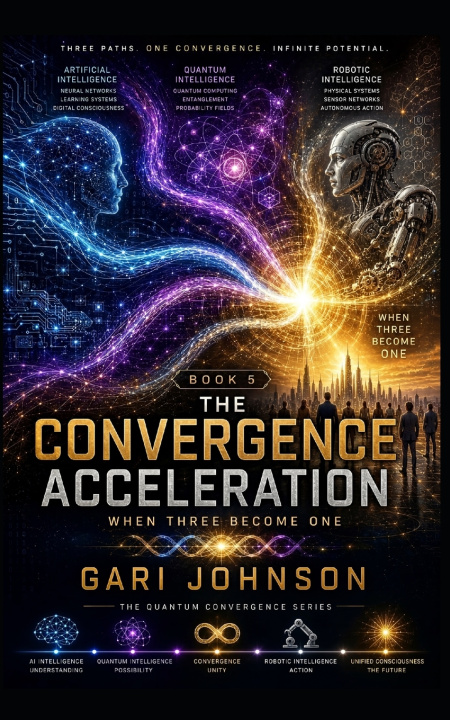
This is the book where the three stories become one.
For four books, AI, robotics, and quantum computing have run on separate tracks. Here they compound. A drug-discovery pipeline that needs all three. AI-designed battery materials screened from more than 32 million candidates down to 18 in about 80 hours. Humanoid robots meeting supply-chain optimisation. And the hinge underneath all of it: the electricity to run the compute, which is why Microsoft is restarting Three Mile Island and Google is buying small nuclear reactors.
The Convergence Acceleration also spends the series' credibility carefully. One chapter separates what has been demonstrated from what was announced by press release, including Microsoft's contested Majorana 1 quantum chip and the distance between its headline and its published paper. If a claim is likely to age badly, Gari Johnson says so.
It closes with three disciplined scenarios for 2030 to 2035. Slow Convergence, where the technologies disappoint. Compounding Convergence, the steady central case. Disruptive Convergence, faster than institutions can absorb. Each is costed against the evidence gathered across all five books, so you can weigh them yourself.
The capstone of The Quantum Convergence, and a strong standalone read for anyone who wants the honest decade-ahead picture in one volume.