You highlighted three chapters. You reread the textbook twice. A week later, the exam asked one question, and your mind went blank.
The cognitive science has been clear for sixty years: rereading is one of the least effective study practices ever measured. Highlighting is no better. The technique that beats both - by margins so large the researchers had to double-check their own data - is active recall. Close the source. Try to retrieve what you just read. The act of retrieving is what fixes the memory; rereading only fixes the illusion of one.
Most students have heard of active recall. Most of them do it wrong. They flip flashcards too fast, recognize the answers, and call it retrieval. They never climb past the entry rung - and then conclude the method does not work.
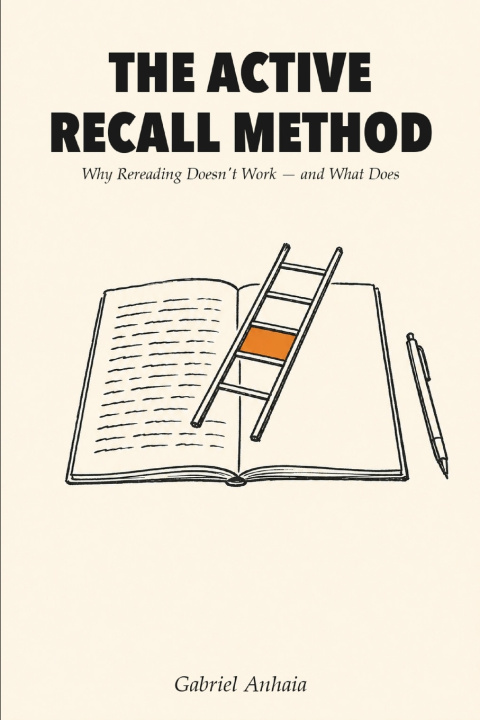
This book teaches the Retrieval Ladder - an original framework that breaks active recall into five distinct levels, each harder than the last, each producing measurably more durable knowledge:
- Level 1 - Cued Retrieval: flashcards designed to test understanding, not recognition
- Level 2 - Free Recall: close the book, write what you remember, find your real curriculum in the gap
- Level 3 - Blank-Page Reconstruction: the linchpin practice. Rebuild a chapter's structure from memory, on paper, with no prompts at all
- Level 4 - Teach-Aloud: explain it out loud to no one, recorded - and find every place your understanding ends and your sense of familiarity begins
- Level 5 - Problem Application: use the knowledge on a question the source never asked
Built on the work of Henry Roediger, Jeffrey Karpicke, Robert Bjork, and the testing-effect literature that filled the Science and Psychological Science pages from 2006 onward - translated into practices a working professional, a medical student, a bar candidate, or a language learner can run on a Tuesday night with a notebook and a pen.
No app required. No subscription. No productivity stack. A blank page, a timer, and the discipline to sit with the discomfort that signals real learning is the entire instrument.
You'll learn how to:
- Audit your current study practice and locate exactly which rung of the ladder you have been stuck on
- Design atomic flashcards that survive a year of review without rotting into pattern-completion
- Run a ten-minute free-recall session after any chapter, lecture, or article
- Rebuild an entire textbook chapter from memory on a single blank page
- Use teach-aloud as a combined retrieval-and-comprehension diagnostic
- Recognize when Level 5 problem application is worth the effort and when it is overkill
- Stop highlighting
Whether you are studying for a board exam, a professional certification, a degree, a language, or simply trying to retain what you read - this book is for you. It is short on purpose. The method is something you do, not something you read about.
Part of the Actually Learn Library, alongside Zettelkasten, Reading That Sticks, Spaced Repetition, Deep Focus, and The Feynman Method.