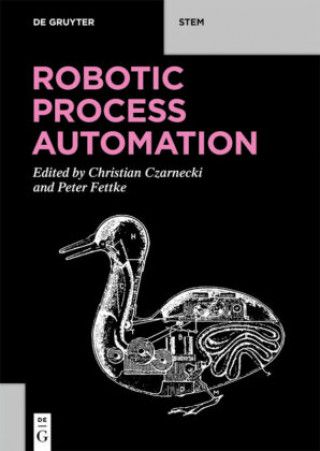
Carte Robotic Process Automation Peter Fettke

Robotic Process Automation

Autor: Peter Fettke
Limbă: engleză
Legare: Carte broșată
Editura: De Gruyter
Disponibilitate: În depozitul extern
Expediem în 9-15 zile
264.24 lei
This book brings together experts from research and practice. It includes the design of innovative R...
Informații despre carte

Autor
Limbă
engleză
Legare
Carte - Carte broșată
Publicat
2021
Pagini
430
EAN
9783110676686
ISBN
3110676680
Enbook ID
33380745
Editura
Greutate
752
Dimensiuni
246 x 174 x 29

Descriere completă

This book brings together experts from research and practice. It includes the design of innovative Robot Process Automation (RPA) concepts, the discussion of related research fields (e.g., Artificial Intelligence, AI), the evaluation of existing software products, and findings from real-life implementation projects. Similar to the substitution of physical work in manufacturing (blue collar automation), Robotic Process Automation tries to substitute intellectual work in office and administration processes with software robots (white-collar automation). The starting point for the development of RPA was the observation that - despite the use of process-oriented enterprise systems (such as ERP, CRM and BPM systems) - additional manual activities are still indispensable today. In the RPA approach, these manual activities are learned and automated by software robots, either by defining rules or by observing manual activities. RPA is related to business process management, machine learning, and artificial intelligence. Tools for RPA originated from dedicated stand-alone software. Today, RPA functionalities are also integrated into elaborated process management suites. From a conceptual perspective, RPA can be structured into input components (sensors in the wide sense), an intelligence center, and output components (actuators in the wide sense). From a strategic perspective, the impact of RPA can be related to the support of existing tasks, the complete substitution of human activities, and the innovation of processes as well as business models. At present, high expectations are related to the use of RPA in the improvement of software-supported business processes. Manual activities are learned and automated by software robots that interact with existing applications via the presentation layer. In combination with artificial intelligence (AI) as well as innovative interfaces (e. g., voice recognition) RPA creates a novel level of automation for office and administration processes. Its benefit potential reaches a return on investment (ROI) up-to 800% that is documented in various case studies.

S-ar putea să te intereseze

239.87 lei

Richard III

WILLIAM SHAKESPEARE
105.47 lei
255.24 lei
1 431.45 lei
244.52 lei

Dingoes

Victoria Blakemore
42.97 lei
226.21 lei
486.41 lei
70.98 lei

Introduction to Rpa

Abhinav Sabharwal
41.05 lei
98.79 lei
1 107.74 lei
193.95 lei
228.44 lei
125.29 lei

Outfoxed

Claudia Boldt
41.65 lei

Clienții care au cumpărat această carte au mai cumpărat și

Russische Märchen

Wilhelm Goldschmidt
144.50 lei