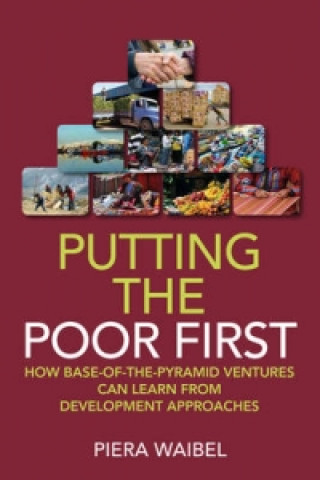
Carte Putting the Poor First Piera Waibel

Putting the Poor First

Autor: Piera Waibel
Limbă: engleză
Legare: Copertă tare
Disponibilitate: șansă 50%
Şanse de a obține acest titlu
433.38 lei
In order to make progress toward the UN Millennium Development Goals - and particularly in terms of...


Informații despre carte

Autor
Limbă
engleză
Legare
Carte - Copertă tare
Publicat
2012
Pagini
244
EAN
9781906093747
ISBN
1906093741
Enbook ID
02096621
Greutate
510
Dimensiuni
163 x 239 x 19

Descriere completă

In order to make progress toward the UN Millennium Development Goals - and particularly in terms of poverty alleviation - business has a pivotal role to play: in terms of core business; purchasing products from the poor; employing them; and selling them affordable services and products. Serving the global 4 billion people at the base of the economic ladder - the Base of the Pyramid (BoP) - with suitable products and services is a new but growing field in research and practice. In the initial years, the focus of BoP was very much on selling products and services to a huge untapped market. Practitioners and academics focused on developing new distribution channels to reach the low-income markets and new technological solutions to address their needs. These first-generation "fortune-finding" approaches are now described as "business to four billion". Over the last few years, however, new priorities have gained prominence. This new value proposition can be framed as "business with four billion" and is "fortune-creating". So-called Next Generation, or BoP 2.0, strategies can bring companies and their target groups closer together. The goal is to co-create new business models as well as product and service solutions together with the target group. Integrating BoP into the innovation process - be it in terms of idea generation, product/service development, production or distribution/marketing - is seen as way to increase not only the impact on poverty alleviation, but also the benefits to the company. This paradigm shift - to co-creation or embedded innovation - in fact closely mirrors a shift previously made by development researchers who argued that the poor should no longer be viewed as the target of poverty reduction efforts, but as partners in, and an asset to, the development process. Bottom-up development approaches - such as Participation, Community-Driven Development, Empowerment, Asset-Based Community Development or Local Knowledge - emphasise the role of the poor and see them as central to the design and implementation of the development process. Even though some BoP researchers consider selective parts of this knowledge in their research, a comprehensive study that rigorously examines BoP ventures from a bottom-up development perspective has not yet been completed. This book attempts to fill that gap. Putting the Poor First examines the applicability of different elements in the bottom-up development literature to the innovation process of BoP ventures. It unveils connections between the two approaches and builds a theoretical base for the case study research. With three in-depth case studies and eight companies participating in a survey, the current state and experiences of businesses applying a bottom-up development perspective with BoP ventures in Latin America and the Caribbean is analysed. The elements of a bottom-up development perspective applied in BoP practice can be grouped into three categories: drivers for choosing a bottom-up development perspective in BoP ventures (e.g. such that products and services are more readily accepted); circumstances that help or hinder the application of a bottom-up development perspective in BoP ventures (e.g. the acceptance of the company by communities or previous experiences with poverty alleviation projects); and success factors when choosing a bottom-up development perspective in BoP ventures (e.g. the importance of power structures, pluralism and self-esteem). The many recommendations, such as empowering the poor by encouraging co-creation and outsourcing innovation, fill gaps in theory, support practitioners and lay the foundations for further research. This will be a key book for BoP researchers and practitioners on the ground. The reconnection of development approaches with BoP strategies puts the poor first.

S-ar putea să te intereseze

Freedom and the Court

Henry J Abraham
265.84 lei
78.01 lei

Mother to Son

Alphonso Simpson
1 478.82 lei

Critical Care Nursing Made Incredibly Easy!

Lippincott Williams & Wilkins
270.08 lei
192.06 lei

Cop On The Run

Arnold M Pine
147.75 lei
227.79 lei

More Than Bollywood

Gregory D. Booth
768.37 lei

Heavenly Court

Lennert Gesterkamp
1 357.61 lei
271.80 lei

Non-Sleeping Universe

Maria Teresa Vaz Torr
893.22 lei
92.65 lei
98.20 lei

Clienții care au cumpărat această carte au mai cumpărat și

Schlußakkord

Günter Hofe
73.37 lei

El fariseo y el publicano

DANIEL LONDOÑO SILVA
13.21 lei
104.65 lei
86.39 lei