Nobody's fingerprints are on any of the bodies.
He arrives in Washington as an idealist and learns, in his first humiliating markup, that sincerity is not a tool that works. So he studies. Over forty years he masters the one thing the chamber truly respects - procedure. The rules were written to make deliberation fair. In his hands they become something else entirely.
You can't command a government. But you can decline to fund one. Programs are never defeated on the floor; they simply never get scheduled. A single negative sentence, eleven words long, quietly unenrolls a million children - and no reporter ever calls, because there is no story where nothing happens. This is his genius, and his ruin: in this system, nothing is the most powerful act available.
He is not a villain. He is the machine's best student - proof of what a well-intentioned system becomes when governance curdles into winning and losing rather than right and wrong. His party is never named. His victims never learn his name, and he never learns theirs. The bodies pile up off-camera: a farm family, a researcher's thawing samples, a bridge authorized and never built, a district food bank gutted in a standoff he himself engineered.
That food bank belongs to his daughter. And the protégé who will one day rise on the floor to end his Speakership - with a motion to vacate, the privileged resolution that has hung on the wall since 1910 - is the son-in-law he trained himself. A man who married into the family because the family was the path to the House, and waited nineteen years to pull the trigger.
First they take his office. Then they take his story.
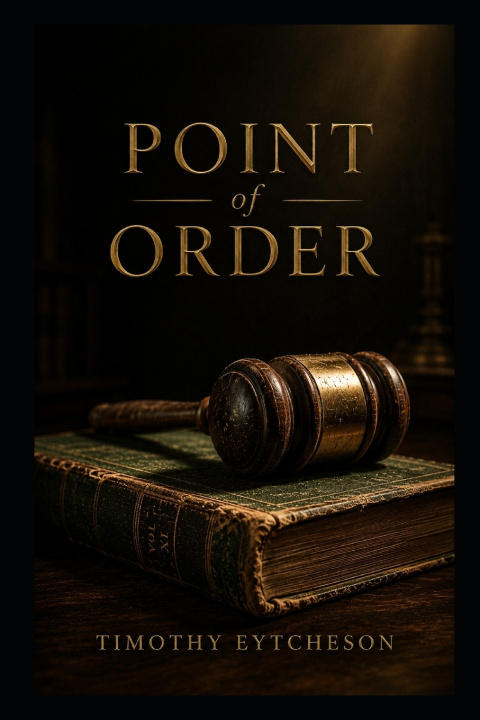
POINT OF ORDER is a novel about the quiet machinery of American power - a forty-year indictment of the machine, not the man. Each chapter opens on a line from the rulebook, growing more sinister as the decades pass and the language of the chamber decays from "getting to yes" into "hostages" and "running out the clock." Nobody in the room ever notices the shift.
By the end, the cycle begins again with a new freshman and one small, sincere act. The chamber's indifference gets the last word. Not despair - entropy.
For readers of Advise and Consent, All the King's Men, and Primary Colors - political fiction for anyone who has ever wondered how so much can go wrong while everyone follows the rules.