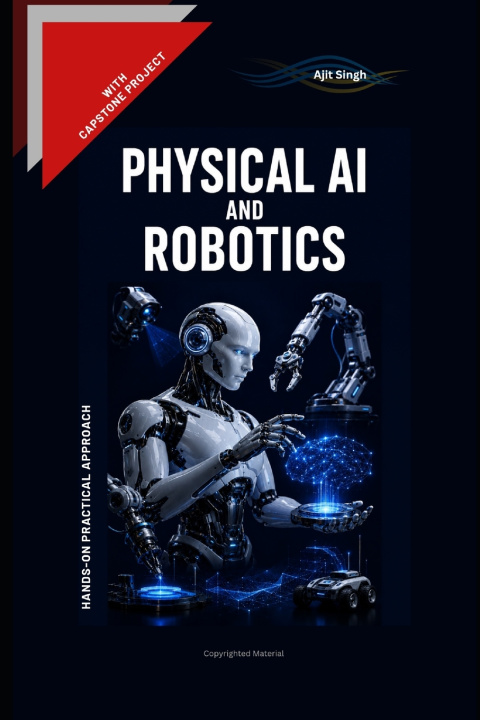
The intersection of artificial intelligence and mechanical engineering has initiated a profound shift in how machines interact with the physical world. For decades, software existed purely in the digital realm, processing data and returning outputs on screens. However, the modern industrial landscape demands more. It requires algorithms to possess physical forms, to perceive dynamic environments, to make autonomous decisions, and to execute precise mechanical actions. This text, "Physical AI and Robotics," is meticulously engineered to address these exact requirements of real-life industry.
Philosophy
The foundational philosophy of "Physical AI and Robotics" is rooted in the concept of "Applied Intelligence." In the modern technological era, artificial intelligence is frequently constrained to digital interfaces. However, true automation requires machines to physically interact with their environments. The philosophy of this book dictates that learning about Physical AI must be a hands-on, action-oriented process. I firmly believe that one cannot master robotics purely through reading equations; mastery is achieved by stripping wires, configuring sensors, training models, and writing code that triggers mechanical movement.
Key Features
1. Scratch to Production: This book covers the entire hardware and software lifecycle. You will learn how to select raw components, wire them, write the firmware, implement AI models, simulate the robot, and deploy the final product.
2. Strictly Practical Orientation: The text is relentlessly focused on building. Theoretical explanations are kept brief and are immediately followed by practical implementation steps.
3. Simplified Algorithmic Logic: Complex robotic operations (like kinematics and path planning) are broken down into beginner-friendly, numbered steps.
4. Industry-Relevant Frameworks: The book utilizes the exact tools used in modern enterprises, including ROS2, edge computing protocols, and current machine learning libraries.
5. Complete DIY Capstone Project: The final chapter provides a full, unredacted codebase and assembly guide for a functional Physical AI project, proving the concepts taught in the previous nine chapters.
6. Logical Sequencing: The chapters are structured to build upon one another perfectly. Hardware fundamentals precede software design, which precedes AI integration, culminating in cloud deployment and production
Key Takeaways
By completing this book, readers will extract highly actionable, industry-ready skills:
1. Architectural Design: The ability to design the complete framework of a Physical AI system, selecting the correct microcontrollers, edge computers, sensors, and actuators for specific tasks.
2. Algorithm Implementation: The skill to write and deploy simplified, efficient algorithms for perception, navigation, and object manipulation using numbered logic structures.
3. AI Integration: A thorough understanding of how to train machine learning models and deploy them directly onto physical robotic hardware for real-time decision-making.
4. Simulation to Reality: Expertise in building digital twins, allowing for safe testing of robotic code in simulated environments before pushing the code to the physical machine.
5. Production Deployment: The knowledge required to take a workbench prototype, ruggedize it, connect it to cloud services, and deploy it as a final, reliable production unit in an industry setting.
6. End-to-End Development: The confidence to conceptualize a robotic application, build it from scratch, and deliver a fully functioning Physical AI solution.
Disclaimer: Earnest request from the Author.
Kindly go through the table of contents and refer kindle edition for a glance on the related contents.
Thank you for your kind consideration!