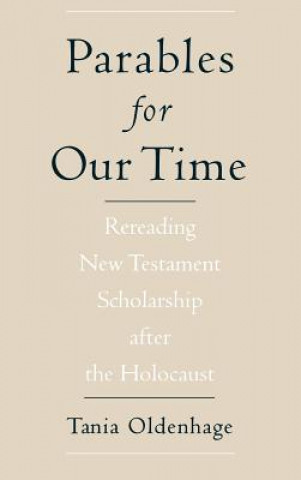
Carte Parables for Our Time Tania Oldenhage

Parables for Our Time

Rereading New Testament Scholarship after the Holocaust

Limbă: engleză
Legare: Copertă tare
Disponibilitate: În depozitul extern
Expediem în 10-18 zile
405.02 lei
Over the centuries, New Testament texts have often been read in ways that reflect and encourage anti...
Informații despre carte

Limbă
engleză
Legare
Carte - Copertă tare
Publicat
2002
Pagini
200
EAN
9780195150520
ISBN
019515052X
Enbook ID
04515530
Greutate
452
Dimensiuni
165 x 241 x 19

Descriere completă

Over the centuries, New Testament texts have often been read in ways that reflect and encourage anti-Semitism. For example, the parable of the "wicked husbandmen," who kill the son of their landlord in order to seize the land, has been used to blame the Jews for the death of Christ. Since the Holocaust, Christian scholars have increasingly recognized and rejected this inheritance. In Parables for Our Time Tania Oldenhage seeks to fashion a biblical hermeneutics that consciously works with memories of the Holocaust. New Testament scholars have not directly confronted the horror of Nazi crimes, Oldenhage argues, but their work has nonetheless been deeply affected by the events of the Holocaust. By placing twentieth-century biblical scholarship within its specific historical and cultural contexts, she is able to trace the process by which the Holocaust gradually moved into the collective consciousness of New Testament scholars, both in Germany and in the United States. Her focus is on the scholarly interpretation of the parables of Jesus. She sets the stage with the work of Wolfgang Harnisch who exemplifies the problems surrounding Holocaust remembrance in the Germany of the 1980s and 1990s. She then turns to Joachim Jeremias's eminent work on the parables, first published in 1947. Jeremias's anti-Jewish rhetoric, she argues, should be understood not only as a perpetuation of an age-old interpretive pattern, but as representative of German difficulties in responding to the Holocaust immediately after the war. Oldenhage goes on to explore the way in which Jeremias's approach was challenged by biblical scholars in the U.S. during the 1970s. In particular, she examines the turn to literature and literary theory exemplified in the works of John Dominic Crossan and Paul Ricoeur. Nazi atrocities became part of the cultural reservoir from which Crossan and Ricoeur drew, she shows, although they never engaged with the historical facts of the Holocaust. In conclusion, Oldenhage offers her own reading of the parable of the wicked husbandmen, demonstrating how the turn from historical to literary criticism opens up the text to interpretation in light of the Holocaust. If the parables are to be meaningful in our time, she contends, we must take account of the troubling resonances between these ancient Christian stories and the atrocities of Auschwitz.

S-ar putea să te intereseze

Indian Bourgeoisie

David Lockwood
1 141.92 lei

Heavy Petting

ERIN NICHOLAS
88.31 lei

The Problem with Men

Beverley Scherberger
64.89 lei

Damaged Goods

Susan Mac Nicol
45.61 lei
44.50 lei

TERRANOVA SUCCESS STRATEGIES G

Terranova Exam Secrets Test Prep
195.69 lei

Garden

R J Ramirez
123.13 lei

Nazi Childhood

Winfried Weiss
74.58 lei
165.41 lei

Robert Mitchum

Lee Server
98.20 lei

King Jesus Gospel

Scot McKnight
73.37 lei

Clienții care au cumpărat această carte au mai cumpărat și

275.33 lei
128.58 lei
77.51 lei