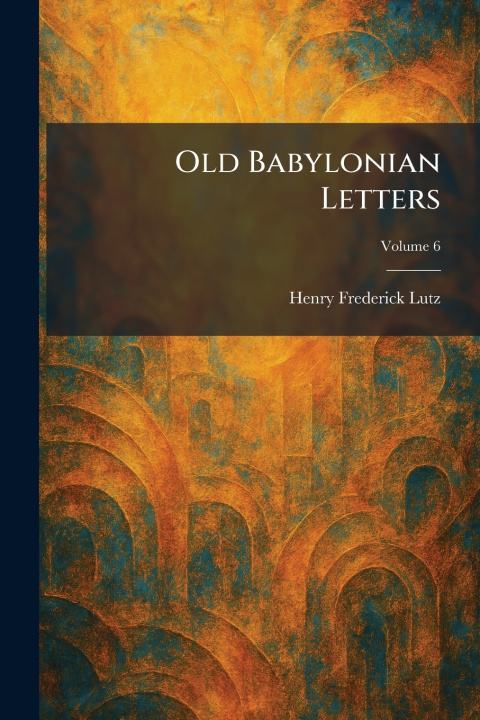
"Old Babylonian Letters" is a significant scholarly contribution to the field of Assyriology, presenting a meticulously curated collection of correspondence from one of antiquity's most influential periods. Authored by the esteemed scholar Henry Frederick Lutz, this volume provides primary source material that offers an intimate look into the social, economic, and administrative life of ancient Mesopotamia.
The letters contained herein serve as vital linguistic and historical artifacts, reflecting the complexities of daily interactions, legal disputes, and official communications during the Old Babylonian era. By examining these texts, researchers and history enthusiasts gain invaluable insights into the development of the Akkadian language and the structural foundations of Babylonian society. This volume continues the rigorous philological tradition of documenting cuneiform records, ensuring that these ancient voices remain accessible for academic study.
"Old Babylonian Letters" remains an essential resource for those specializing in Semitic languages, ancient history, and the archaeological study of the Near East, bridging the gap between modern scholarship and the distant past through the power of written word.
This work has been selected by scholars as being culturally important, and is part of the knowledge base of civilization as we know it. This work was reproduced from the original artifact, and remains as true to the original work as possible. Therefore, you may see the original copyright references, library stamps (as most of these works have been housed in our most important libraries around the world), and other notations in the work.
This work is in the public domain in the United States of America, and possibly other nations. Within the United States, you may freely copy and distribute this work, as no entity (individual or corporate) has a copyright on the body of the work.
As a reproduction of a historical artifact, this work may contain missing or blurred pages, poor pictures, errant marks, etc. Scholars believe, and we concur, that this work is important enough to be preserved, reproduced, and made generally available to the public. We appreciate your support of the preservation process, and thank you for being an important part of keeping this knowledge alive and relevant.