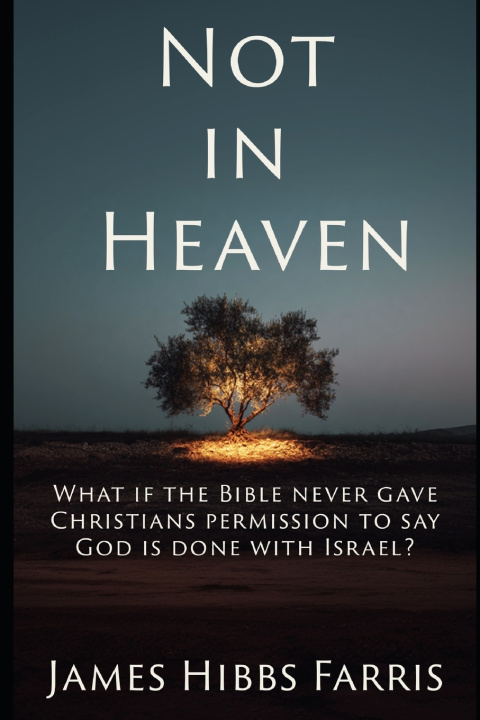
What if the Bible never gave Christians permission to say God is finished with Israel?
Sitting at a kitchen table in Louisiana with a rosary on one side and a volume of Talmud on the other, the author stumbled into a different world: the Jewish beit midrash, where argument is reverence and Torah is "not in heaven" but entrusted to human hands. There he met the God of the Oven of Akhnai, who lets a heavenly voice be overruled and laughs, "My children have defeated Me." That God would not fit inside the replacement story he had been told.
Not in Heaven is the story of what happens when a serious Christian lets that discovery work all the way through Romans 11, Jeremiah 31, the Shoah, Catholic teaching, and the living voices of the rabbis. Refusing both vague "all paths are the same" relativism and old‑style triumphalism, the book:
- Takes Paul at his word - reading Romans 11's olive tree, "all Israel will be saved," and "God's gifts and his call are irrevocable" without the usual supersessionist escape hatches.
- Lets Jeremiah 31 mean what it says - a "new covenant" with the house of Israel and the house of Judah, with God's own Torah written on their hearts, not a blank check to replace Israel with "the Church."
- Listens to Jewish sources as real theology - classic passages like Lo ba'shamayim hi, God's tefillin, the Red Heifer, Acher, and the suffering Messiah at the gates of Rome are heard on their own terms, not used as sermon props.
- Names replacement theology clearly - hard, soft, and "spiritual" supersessionism are shown to fail biblically, logically, and morally.
- Speaks as an insider, not an ex‑anything - the author remains rooted in Christian sacramental life even as he lets Jewish critique, history, and Scripture pressure the Church's habits of speech.
This is not a book about "becoming Jewish," and it is not an invitation to leave the Church. It is a call for Christians to read their own Scriptures with greater honesty, to let "Israel" mean Israel wherever the Bible says it, and to see Jewish covenantal life as a living witness to God's faithfulness rather than a problem to be solved.
If you love the Bible but wince at talk of the Church "replacing" Israel, if you are Jewish and wonder whether any Christian theology can honor Israel without swallowing it, or if you are simply tired of being told that reverence means never arguing with the story,
Not in Heaven invites you to pull up a chair in the beit midrash-a room where Israel and the Church, rabbis and apostles, stand under the same hard Scriptures and the same patient God, and where the measure of faithfulness is not who wins the argument, but who refuses to pretend that God has broken His first promises.