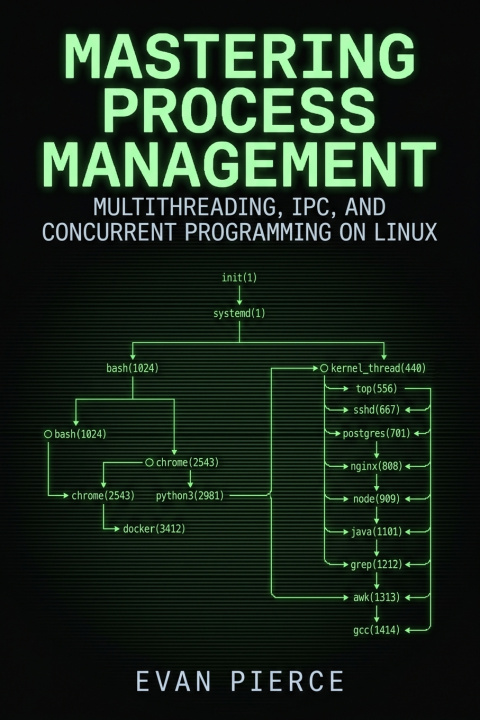
Stop writing code that merely runs. Start building systems that command the hardware.
As software complexity grows, sequential execution is no longer sufficient. Modern hardware scales horizontally, demanding applications that leverage true concurrent architecture. This comprehensive, technically rigorous guide bridges the gap between basic C programming and professional systems engineering on Linux.
Moving beyond theoretical concepts, this book delivers the practical skills required to design, debug, and optimize production-grade systems software. You will master the unique challenges of multithreading, safely share data across isolated memory spaces, and architect systems immune to catastrophic deadlocks and silent data races.
Inside, you will explore:
The Linux Process Lifecycle: Master virtual memory layouts, safe termination, and the precise mechanics of process duplication.
Interprocess Communication (IPC): Build secure, high-throughput data pathways using anonymous pipes, POSIX shared memory, message queues, and Unix domain sockets.
POSIX Threads and Synchronization: Implement true multithreading and protect shared resources utilizing mutexes, condition variables, and reader-writer locks.
Advanced Concurrency: Design scalable thread pools, explore lock-free programming with C11 atomic operations, and leverage asynchronous, event-driven architectures like epoll and io_uring.
Performance Optimization: Navigate CPU cache hierarchies, eliminate false sharing, and utilize advanced profiling tools like perf and Valgrind to extract maximum hardware performance.
Production Readiness: Deploy autonomous watchdog threads, implement graceful shutdown sequences, and harden your software against security vulnerabilities.
Whether you are transitioning into systems engineering or optimizing existing server applications, this manual provides the absolute technical precision required to succeed.
Elevate your engineering capabilities and forge architectures that refuse to compromise.