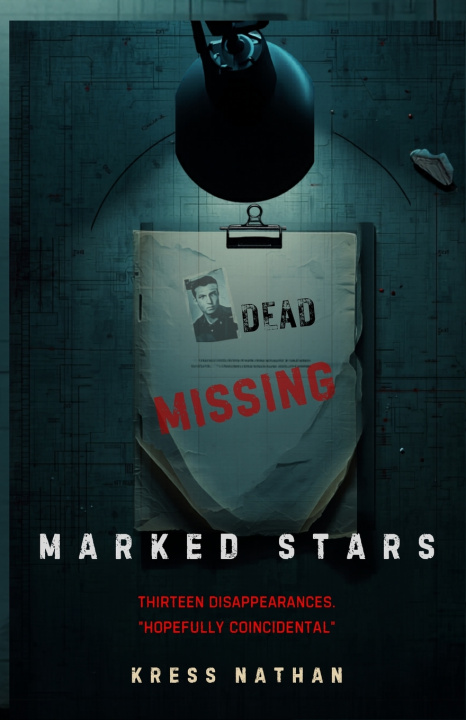
Thirteen American scientists. Eleven dead or vanished. The pattern is too precise to be a coincidence.
On a Tuesday afternoon in early April, the file lands on senior congressional investigator Margaret Kwan's desk without a routing slip. Eleven of thirteen names hold a clearance designation that does not appear in the standard taxonomy. Two are already dead. One - a retired Air Force general - has walked out of his Albuquerque home in February with a revolver and his hiking boots, leaving his prescription glasses on the breakfast table and his wife at the top of the stairs.
Margaret has spent eleven years inside the architecture of American institutional secrecy. She knows what she is permitted to ask and what she is not. She knows what happens to the people who notice the difference. And by the time she has driven to Georgetown that night to ask a retired British intelligence officer what the designation means, the system she has spent her career inside has begun, quietly and without her permission, to register her interest.
Across the next eleven months, Margaret and Dario Suárez - an FBI agent assigned to look for connections, then ordered to stop - assemble the disassembly of a program that was never a cover-up. Quorum was a designed system: Cold War-era, bilateral, intentional. An architecture that distributed weapons-failure-mode knowledge across thirteen American carriers on the principle that knowledge held in pieces could not be weaponized. By the time the file reaches Margaret's desk, eleven of the thirteen are dead. The bureaucrat coordinating the executions believes, correctly, that what he is doing falls within the scope of a standing authorization issued in 1987 and never formally rescinded.
The architecture is operating exactly as designed. That is the problem.
In the tradition of literary thrillers, Marked Stars is about the architecture of secrecy and the conscience that has to live inside it. It asks: what is a secret worth, and who decides who pays the price for keeping it?