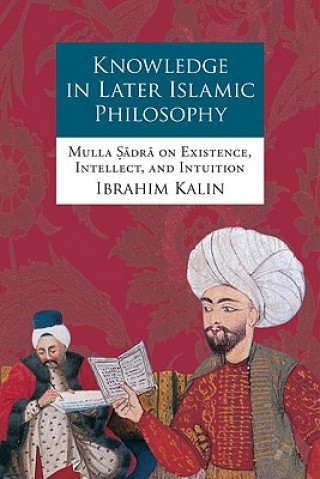
Carte Knowledge in Later Islamic Philosophy Ibrahim Kalin

Knowledge in Later Islamic Philosophy

Mulla Sadra on Existence, Intellect, and Intuition

Autor: Ibrahim Kalin
Limbă: engleză
Legare: Copertă tare
Disponibilitate: În depozitul extern
Expediem în 10-18 zile
582.96 lei
This study looks at how the seventeenth-century philosopher Sadr al-Din al-Shirazi, known as Mulla S...


Informații despre carte

Limbă
engleză
Legare
Carte - Copertă tare
Publicat
2010
Pagini
344
EAN
9780199735242
ISBN
0199735247
Enbook ID
04535238
Greutate
532
Dimensiuni
147 x 218 x 29

Descriere completă

This study looks at how the seventeenth-century philosopher Sadr al-Din al-Shirazi, known as Mulla Sadra, attempted to reconcile the three major forms of knowledge in Islamic philosophical discourses: revelation (Qur'an), demonstration (burhan), and gnosis or intuitive knowledge ('irfan). In his grand synthesis, which he calls the 'Transcendent Wisdom', Mulla Sadra bases his epistemological considerations on a robust analysis of existence and its modalities. His key claim that knowledge is a mode of existence rejects and revises the Kalam definitions of knowledge as relation and as a property of the knower on the one hand, and the Avicennan notions of knowledge as abstraction and representation on the other. For Sadra, all these theories land us in a subjectivist theory of knowledge where the knowing subject is defined as the primary locus of all epistemic claims. To explore the possibilities of a 'non-subjectivist' epistemology, Sadra seeks to shift the focus from knowledge as a mental act of representation to knowledge as presence and unveiling. The concept of knowledge has occupied a central place in the Islamic intellectual tradition. While Muslim philosophers have adopted the Greek ideas of knowledge, they have also developed new approaches and broadened the study of knowledge. The challenge of reconciling revealed knowledge with unaided reason and intuitive knowledge has led to an extremely productive debate among Muslims intellectuals in the classical period. In a culture where knowledge has provided both spiritual perfection and social status, Muslim scholars have created a remarkable discourse of knowledge and vastly widened the scope of what it means to know. For Sadra, in knowing things, we unveil an aspect of existence and thus engage with the countless modalities and colours of the all-inclusive reality of existence. In such a framework, we give up the subjectivist claims of ownership of meaning. The intrinsic intelligibility of existence, an argument Sadra establishes through his elaborate ontology, strips the knowing subject of its privileged position of being the sole creator of meaning. Instead, meaning and intelligibility are defined as functions of existence to be deciphered and unveiled by the knowing subject. This leads to a redefinition of the relationship between subject and object or what Muslim philosophers call the knower and the known.

S-ar putea să te intereseze

Stoic Warriors

Nancy Sherman
99.46 lei

Ketamine

Bita Moghaddam
71.00 lei
81.66 lei
87.30 lei

Dooku: Jedi Lost

Cavan Scott
69.69 lei
207.79 lei

Writing Song Lyrics

Glenn Fosbraey
557.31 lei
116.06 lei
133.87 lei
92.12 lei

Anne of Green Gables

Lucy Maud Montgomery
54.71 lei
63.06 lei
245.01 lei

Clienții care au cumpărat această carte au mai cumpărat și

112.84 lei

The Hunger Games 1

Suzanne Collins
90.71 lei