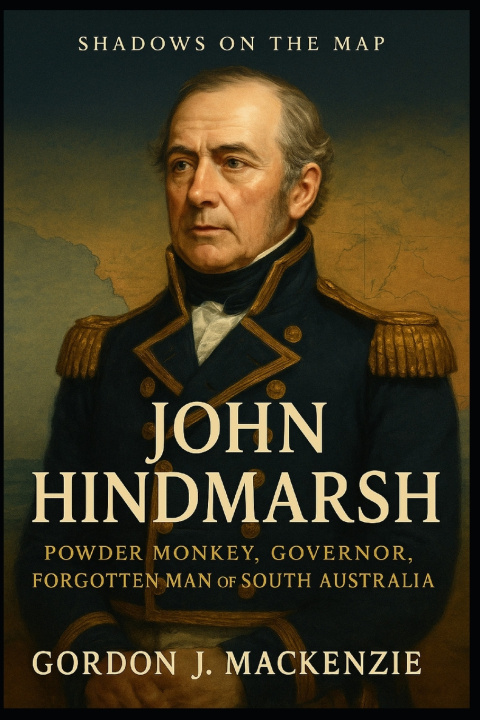
John Hindmarsh was the first Governor of South Australia, but his name has survived more clearly than his story.
Before he stood at Holdfast Bay in 1836 to proclaim the new province, Hindmarsh had lived a life shaped by war, rank, ambition and grievance. Born into the naval world of Chatham, he entered the Royal Navy as a boy and was formed by the brutal discipline of ships, guns and battle. The same Navy that gave him courage and status also left him hungry for recognition in the long years after war.
When he was appointed Governor of South Australia, Hindmarsh seemed to have found the honour he had spent decades seeking. Instead, he entered one of the most unstable colonial experiments in the British Empire.
South Australia was planned as a free colony, different from the convict settlements of the east. It promised order, land, opportunity and respectability. Its founding proclamation also promised protection for Aboriginal inhabitants. Yet behind those ideals lay a divided system of authority, a land scheme dependent on rapid survey and sale, and the unavoidable reality that British settlement was being imposed on Kaurna country.
Hindmarsh stood at the centre of that contradiction.
He was brave, but brittle. Loyal, but resentful. Experienced in command, but poorly suited to civilian compromise. His quarrels with James Hurtle Fisher and William Light exposed the weakness of South Australia's early government. His conflict with settlers and officials revealed how quickly colonial ideals could collapse into faction. His recall made him a public failure, yet his name remained fixed in South Australian memory.
John Hindmarsh: Powder Monkey, Governor, Forgotten Man of South Australia follows Hindmarsh from the gun decks of Britain's naval wars to the beach at Holdfast Bay, from the founding ceremony of South Australia to the humiliation of recall, and from later imperial service to his uneasy afterlife on the map.
This is not a simple story of heroism or failure. It is the story of a man who wanted honour and became evidence: evidence of naval Britain, class ambition, flawed colonial design, humanitarian language, Indigenous dispossession and the way public memory preserves names while flattening lives.
Part of the Shadows on the Map series, this book restores the man behind the name and places him back inside the troubled beginning of South Australia.