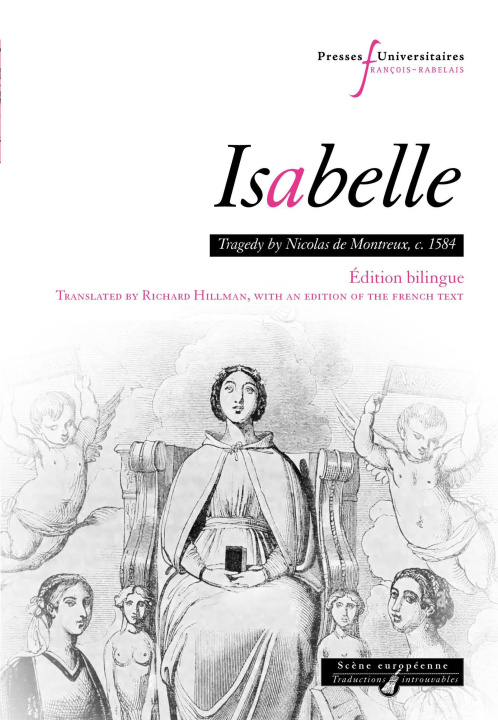
Auteur prolifique dans un large éventail de genres, Nicolas de Montreux (1561 ?-1608 ?) publie sa tragédie Isabelle en annexe du quatrième volume des populaires Bergeries en 1595. Pourtant la bibliographie de La Croix du Maine atteste que la pièce a été accessible avant 1584, figurant ainsi parmi les premières tragédies de l'auteur, précédant Cleopatre (v. 1592) et Sophonisbe (1601). Isabelle glorifie une femme courageuse qui choisit d'échapper par la mort à la captivité, et à la menace à sa chasteté, une intrigue tirée, non pas de sources historiques classiques, mais de l'Orlando Furioso. En effet, cette romance épique extrêmement populaire de Ludovico Ariosto a fortement influencé l'écriture de Montreux pendant les premières années de sa carrière. Mais bien que l'on retrouve cette thématique à travers son oeuvre, Isabelle est la seule tragédie de l'auteur à se concentrer particulièrement sur la vertu de la chasteté - au point que l'héroïne meurt en quasi-martyr chrétien en défendant sa fidélité à son défunt mari Zeobin contre les avances insistantes de son ravisseur, le brutal Maure Rodomont.Malgré cette moralité schématique, la tragédie de Montreux est novatrice à bien des égards, d'une part par sa source, mais aussi par rapport à la tragédie humaniste en général. Dans Isabelle, l'amour de l'héroïne pour son défunt époux s'oppose aux pulsions brutes de Rodomont - soulagement sexuelle, affirmation du pouvoir - mais aussi à l'arbitraire et à l'irrésistible de l'Amour terrestre lui-même tel qu'il se déploie dans l'Orlando Furioso, où l'attirance et la répulsion sont instantanées et réversibles, et où la folie peut survenir. Vu de cette perspective, et comme le présente le dramaturge, même le méchant Rodomont partage finalement le statut de victime tragique.Although all extant copies seemingly date from its 1595 publication, when the tragedy was appended to the fourth volume of the author's popular “Bergeries”, reliable bibliographical evidence shows that Isabelle was accessible prior to 1584. It therefore figured among the first dramatic works of Nicolas de Montreux (1561?-1608?) – a prolific author in a wide range of genres, who published under the anagrammatical pseudonym of Ollenix du Mont-Sacré. It is certainly the earliest of his three surviving tragedies, and it is both distinct from, and linked to, its successors. Like Cleopatre (c. 1592) and Sophonisbe (1601), Isabelle exalts a courageous woman who chooses to escape captivity through death. Its plot is taken not from classical historical sources, however, but from Ludovico Ariosto's enormously popular epic romance, Orlando Furioso, a strong influence on Montreux's writing throughout his early career. And while the theme also echoes in the later tragedies, only Isabelle so intensely focuses on the particular virtue of chastity – to the point where the heroine dies a virtual Christian martyr in defending her fidelity to her deceased husband Zeobin against the insistent advances of her captor, the brutal Moor Rodomont.Despite such schematic morality, Montreux's tragedy is arguably innovative in important respects, notably in relation to its source, but also with respect to humanist tragedy in general. Most striking is its development of the character of Rodomont, who combines the ridiculous boasting of a miles gloriosus with the sufferings of a courtly lover and finally resolves on rape in response to the perceived threat to his dominance. Yet when Isabelle thwarts his intention by bringing about her death – and, moreover, implicates him in the act by an ingenious ruse – his sense of loss and guilt earns him a pitiful share in the tragedy. He thereby anticipates the stricken Octavius Caesar in Montreux's Cleopatre, where the heroine's love for Antony is endowed with a sacred spirituality akin to that of Isabelle and Zeobin.In Isabelle, such love is set off against Rodomont's crude drives – to sexual release, to assertion of power – but also against the arbitrary and irresistible operations of Love itself as deployed in the Orlando Furioso, where attraction and revulsion are instantaneous and reversible, and madness may result.