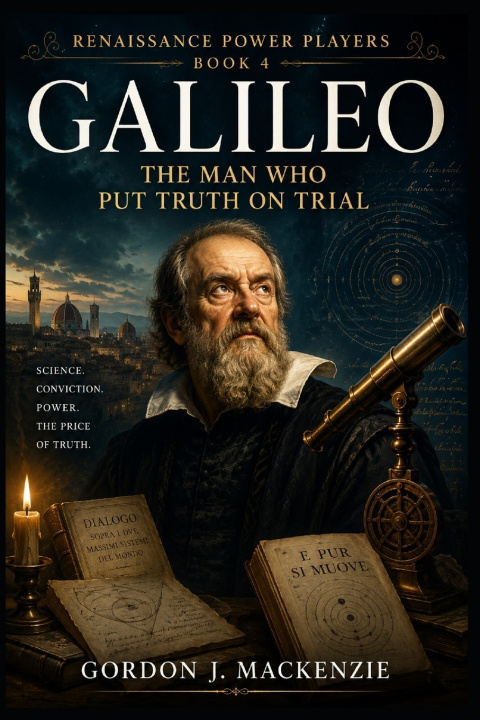
Galileo Galilei did not merely look at the heavens. He made them dangerous.
With a telescope, he saw a Moon scarred by mountains, moons circling Jupiter, phases of Venus, spots on the Sun, and stars hidden from the naked eye. These discoveries did more than challenge old astronomy. They threatened an entire structure of inherited authority, where Aristotle, Ptolemy, scripture, universities, courts, and Rome all helped define what educated Europeans believed about the universe.
Galileo was brilliant, ambitious, devout, combative, and dangerously gifted with words. He did not simply observe. He argued. He published. He mocked. He turned evidence into drama and made the Copernican universe impossible to ignore.
Summoned before the Roman Inquisition in 1633, Galileo was forced to recant the moving Earth. Yet the trial could not make Jupiter's moons disappear, smooth the mountains of the Moon, erase the phases of Venus, or stop the new science of motion from reshaping the world.
Galileo: The Man Who Put Truth on Trial is the story of a restless mind caught between Renaissance ambition and modern science, between faith and evidence, between patronage and punishment, and between the authority of Rome and the authority of nature itself.