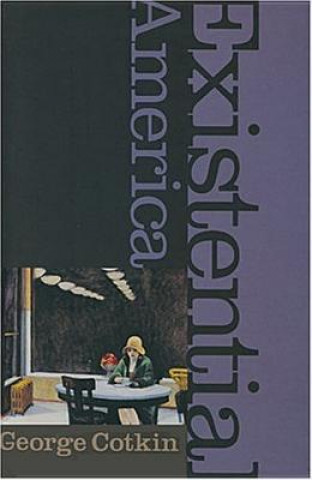
Carte Existential America George Cotkin

Existential America

Autor: George Cotkin
Limbă: engleză
Legare: Carte broșată
Disponibilitate: În depozitul extern
Expediem în 9-15 zile
226.38 lei
Europe's leading existential thinkers-Jean-Paul Sartre, Simone de Beauvoir, and Albert Camus-all fel...


Informații despre carte

Limbă
engleză
Legare
Carte - Carte broșată
Publicat
2005
Pagini
368
EAN
9780801882005
ISBN
0801882001
Enbook ID
04709580
Greutate
574
Dimensiuni
235 x 157 x 30

Descriere completă

Europe's leading existential thinkers-Jean-Paul Sartre, Simone de Beauvoir, and Albert Camus-all felt that Americans were too self-confident and shallow to accept their philosophy of responsibility, choice, and the absurd. "There is no pessimism in America regarding human nature and social organization," Sartre remarked in 1950, while Beauvoir wrote that Americans had no "feeling for sin and for remorse" and Camus derided American materialism and optimism. Existentialism, however, enjoyed rapid, widespread, and enduring popularity among Americans. No less than their European counterparts, American intellectuals participated in the conversation of existentialism. In Existential America, historian George Cotkin argues that the existential approach to life, marked by vexing despair and dauntless commitment in the face of uncertainty, has deep American roots and helps to define the United States in the twentieth-century in ways that have never been fully realized or appreciated. As Cotkin shows, not only did Americans readily take to existentialism, but they were already heirs to a rich tradition of thinkers-from Jonathan Edwards and Herman Melville to Emily Dickinson and William James-who had wrestled with the problems of existence and the contingency of the world long before Sartre and his colleagues. After introducing this concept of an American existential tradition, Cotkin examines how formal existentialism first arrived in America in the 1930s through discussion of Kierkegaard and the early vogue among New York intellectuals for the works of Sartre, Beauvoir, and Camus. Cotkin then traces the evolution of existentialism in America: its adoption by Richard Wright and Ralph Ellison to help articulate the African-American experience; its expression in the works of Norman Mailer and photographer Robert Frank; its incorporation into the tenets of the feminist and radical student movements of the 1960s; and its lingering presence in contemporary American thought and popular culture, particularly in such films as Crimes and Misdemeanors, Fight Club and American Beauty. The only full-length study of existentialism in America, this highly engaging and original work provides an invaluable guide to the history of American culture since the end of the Second World War.

S-ar putea să te intereseze

Way Up North in Dixie

Howard L. Sacks
134.53 lei
480.92 lei
2 797.58 lei

Redemption at Creekside

Keith A. Nonemaker
62.87 lei
213.96 lei