Carte Evaluating Demand Response Opportunities for Data Centers Sonja Klingert

Evaluating Demand Response Opportunities for Data Centers

Limbă: engleză
Legare: Carte broșată
Editura: Cuvillier
Disponibilitate: În depozitul extern
Expediem în 10-18 zile
391.51 lei
Data center demand response is a solution to a problem that is just recently emerging: Today's energ...


Informații despre carte

Limbă
engleză
Legare
Carte - Carte broșată
Publicat
2020
Pagini
286
EAN
9783736973305
ISBN
3736973306
Enbook ID
33553585
Editura
Greutate
364
Dimensiuni
209 x 148 x 20

Descriere completă

Data center demand response is a solution to a problem that is just recently emerging: Today's energy system is undergoing major transformations due to the increasing shares of intermittent renewable power sources as solar and wind. As the power grid physically requires balancing power feed-in and power draw at all times, traditionally, power generation plants with short ramp-up times were activated to avoid grid imbalances. Additionally, so-called demand response schemes may incentivize power consumers to manipulate their planned power profile in order to activate hidden sources of flexibility. The data center industry has been identified as a suitable candidate for demand response as it is continuously growing and relies on highly automated processes.

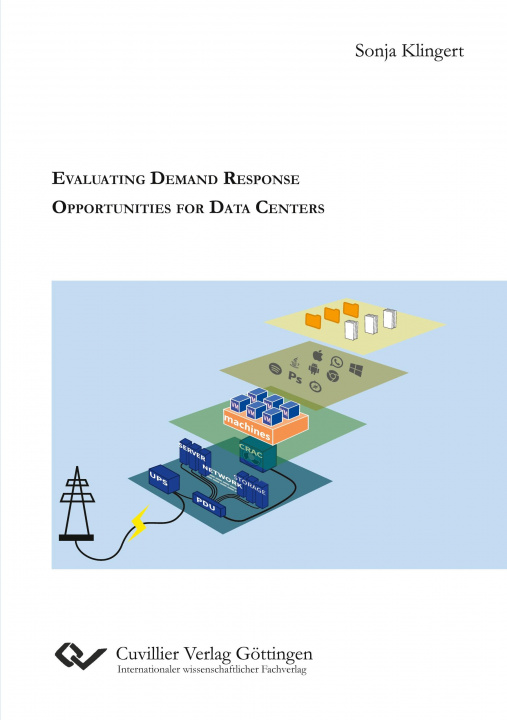
The presented thesis exceeds the related work by creating a framework for modeling data center demand response on a high level of abstraction that allows subsuming a great variety of specific models. Based on a generic architecture of demand response enabled data centers this is formalized through a micro-economics inspired optimization framework that generates technical power flex functions and an associated cost and market skeleton.

This is evaluated through a simulation based on 2014 data from a real HPC data center in Germany, implementing two power management strategies, namely temporal workload shifting and manipulating the CPU frequency. The flexibility extracted is then monetized on two German electricity markets. As a result, in 2014 this data center would have achieved the largest benefit by changing from static electricity pricing to dynamic EPEX prices without changing their power profile. Through demand response they might have created an additional gross benefit of 4% of the power bill on the secondary reserve market. In a sensitivity analysis, however, it could be shown that these results are largely dependent on specific parameters as service level agreements and job heterogeneity. The results show

S-ar putea să te intereseze

592.90 lei
676.14 lei

Great Wall of China

Elizabeth Noll
84.63 lei
205.81 lei

Southwest

Helen Foster James
154.89 lei

Hercules

Jennifer Posedel
132.44 lei
439.52 lei
173.10 lei
173.10 lei

Snow Bugs

David A. Carter
62.19 lei

Clienții care au cumpărat această carte au mai cumpărat și