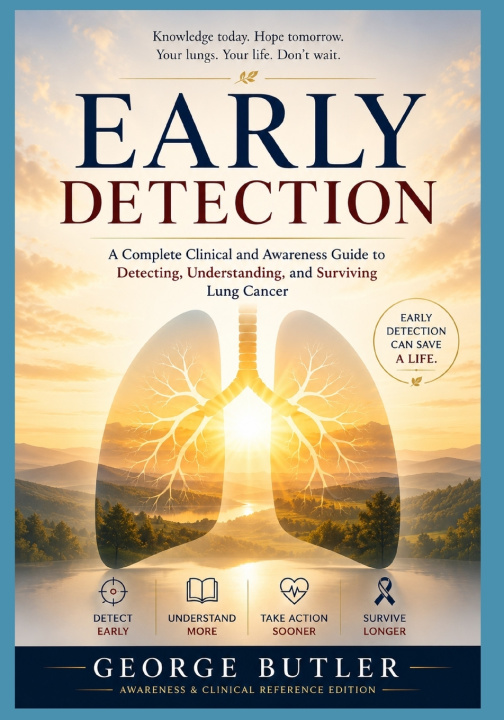
Carte Early Detection George Butler

Early Detection

A Complete Clinical and Awareness Guide to Detecting, Understanding, and Surviving Lung Cancer

Autor: George Butler
Limbă: engleză
Legare: Carte broșată
Disponibilitate: Așteptăm intrarea în stoc
Ediția 05. 06. 2026
117.30 lei
Every year, lung cancer kills more people than breast, prostate, and colon cancer combined. Most of...

Informații despre carte

Limbă
engleză
Legare
Carte - Carte broșată
Publicat
2026
Pagini
262
EAN
9798199230520
Enbook ID
52749494
Greutate
462
Dimensiuni
178 x 254 x 14

Descriere completă

Every year, lung cancer kills more people than breast, prostate, and colon cancer combined. Most of them had symptoms. Most of them delayed.

This book exists to reduce that

Early Detection is the most comprehensive lung cancer awareness and clinical reference guide written for real people - patients, families, caregivers, and anyone who has ever dismissed a cough as nothing worth worrying about. Written by George Butler, this book does not read like a medical textbook. It reads like a conversation with someone who knows exactly what is at stake and refuses to let you look away.

What This Book Covers:

  • The 5 types of lung cancer - from the most survivable (pulmonary carcinoid, ~90% five-year survival) to the most lethal (small cell lung cancer, ~6%) with survival tables, molecular profiles, and full treatment breakdowns
  • The symptoms people miss - the persistent cough, the shoulder pain misdiagnosed as a rotator cuff injury, the breathlessness written off as aging, the hoarseness dismissed as laryngitis
  • The complete diagnostic pathway - from chest X-ray to liquid biopsy, from PET-CT to next-generation sequencing, from the first appointment to the multidisciplinary tumor board
  • Every treatment option in full- surgery, SBRT, chemotherapy, immunotherapy, and targeted therapy including EGFR, ALK, ROS1, KRAS, RET, NTRK, and HER2 - explained with the depth a patient deserves and the clarity they can actually use
  • Six real patient stories - including a 29-year-old non-smoker dismissed three times, a 67-year-old too afraid to seek help, and a woman whose persistence in demanding a CT scan saved her life
  • A dedicated chapter on lung cancer in non-smokers - because 15-20% of patients have never smoked, and far too many are diagnosed too late because everyone assumed they were safe
  • A complete caregiver guide- how to notice symptoms in someone hiding them, how to start the conversation, how to sustain yourself through the caregiving role and how to support children through a family member's diagnosis
  • Clinical trials explained- what the phases mean, how to find trials, your rights as a participant, and why enrollment matters beyond individual benefit
  • Nutrition and exercise during treatment - what to eat through chemotherapy, how to exercise safely, prehabilitation before surgery, and which supplements to avoid
  • Survivorship in full - scanxiety, fear of recurrence, financial toxicity, sexual health, return to work, and the psychological dimensions of life after treatment
  • End-of-life planning - advance directives, hospice care, managing symptoms in the final days, grief, bereavement, and supporting children through loss
  • A global resources chapter - organizations, hotlines, financial assistance programs, and clinical trial databases across the US, UK, Australia, and Africa
  • A full medical terms index - every drug, mutation, procedure, and syndrome in the book defined in plain language

Who This Book Is For:

  • Anyone recently diagnosed with lung cancer or supporting someone who has been
  • People with a persistent cough, unexplained breathlessness, or chest pain they have been meaning to get checked
  • Non-smokers told not to worry because they don't smoke
  • Caregivers and family members who sense something is wrong but don't know how to raise it
  • Healthcare students and professionals seeking a patient-facing clinical reference
  • Anyone who has lost someone to lung cancer and wants to protect the people still around them

The difference between Stage I and Stage IV is not always biology. It is often time. And time begins with a decision to take a symptom seriously.

Read it. Act on it. Share it with someone who needs it.<...