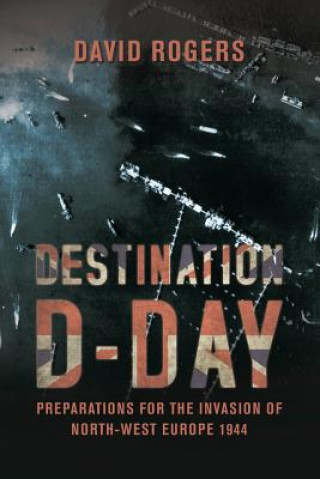
Carte Destination D-Day David Rogers

Destination D-Day

Autor: David Rogers
Limbă: engleză
Legare: Carte broșată
Disponibilitate: șansă 50%
Şanse de a obține acest titlu
215.31 lei
Arguably the Normandy landings were the most complex single operation in the history of modern warfa...


Informații despre carte

Autor
Limbă
engleză
Legare
Carte - Carte broșată
Publicat
2014
Pagini
304
EAN
9781909982055
ISBN
1909982059
Enbook ID
02462509
Greutate
491
Dimensiuni
156 x 234 x 24

Descriere completă

Arguably the Normandy landings were the most complex single operation in the history of modern warfare, maybe of any conflict. Spread over five beaches assigned to both the US and British/Canadian Forces, the need for detailed planning was paramount. There was obviously planning for the assembly of troops and the armada of ships, boats and tugs to transport the men and equipment to their destination. Yet this particular activity was fairly late in the planning stages. For example the Duplex Drive tanks used from D-Day onwards were the subject of a US patent which was filed on 13 March 1942 by N. Straussler. The Beach Groups, a combined British Force comprising all three services, assembled in Scotland in the summer/autumn of 1943, and spent many months on manoeuvres. Operation PLUTO ('pipeline under the ocean') started on 14 August 1942, involving engineers, scientists and members of the armed forces working together to design and develop a pipeline capable of being deployed from the Isle of Wight to the Normandy Beaches, pumping fuel to Normandy. Work on the Mulberry Harbour, the floating temporary harbour erected on two sites supplying British/Canadian soldiers from one beach and the American troops from another, commenced in 1941 at Garlieston, Scotland. Fabrication for the Phoenix caissons (the final chosen construction method) took place along the English South Coast. Some of the Phoenix caissons were abandoned where they were made and are still visible. Further activities were planned to support the French and create an infrastructure. In one case the Royal Engineers landed a train in case the retreating Germans either destroyed the railway network or immobilised the trains. Additionally an organisation, known as Civil Affairs, moved in behind the tanks to set up civil administration. This unit moved slowly through France to Holland. The author provides rich and fascinating detail on these and other aspects of the preparations in the UK for D-Day and the battle for Normandy.

S-ar putea să te intereseze

108.51 lei
198.28 lei

Beyond Terror

Ralph Thornton
165.93 lei

Crazy House

Peter Williams
93.59 lei

Recueil des cours, Collected Courses, Tome/Volume 239 (1993)

cademie de Droit International de la Haye
890.07 lei

Born of Phyre

Frank Underwood Jr
122.31 lei

Canadian Horror Film

André Loiselle
482.81 lei

Paul in Athens

Clare K. Rothschild
637.88 lei

Russian Utopia

Eugene M. Avrutin
419.84 lei

Clienții care au cumpărat această carte au mai cumpărat și

55.41 lei
65.88 lei