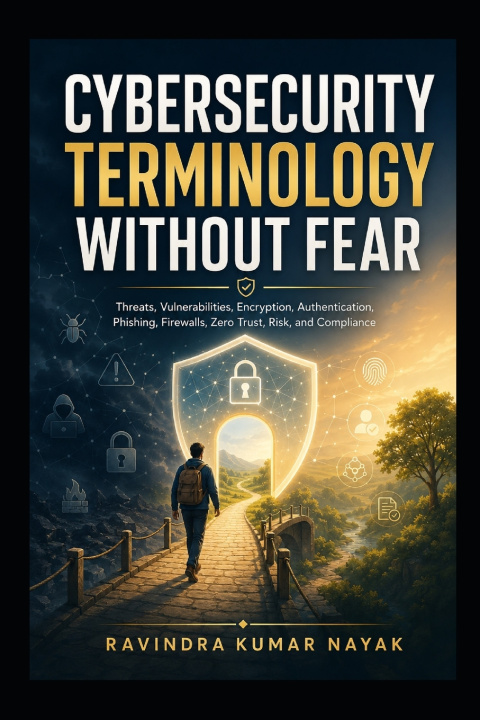
Cybersecurity words can feel frightening when they arrive without meaning.
Threat. Vulnerability. Encryption. Authentication. Phishing. Firewall. Zero trust. Risk. Compliance. Incident response. Audit. Governance.
For many non-technical readers, these words appear in news headlines, office meetings, online safety advice, job descriptions, product discussions, and family conversations. The words sound important, but they often arrive too fast. A reader may understand that cybersecurity matters, yet still feel unsure when someone says a vulnerability increases risk, a firewall needs review, authentication should be strengthened, phishing must be reported, or zero trust changes access decisions.
Cybersecurity Terminology Without Fear is written for that reader.
This book is not a cold dictionary and not a technical manual filled with commands. It is a calm, first-principles learning journey that explains cybersecurity language from the ground up. Every term is treated as a meaningful answer to a real protection problem. Before asking the reader to memorize definitions, the book asks the deeper question: Why did this word need to exist?
Step by step, the reader learns how cybersecurity begins with value. A lock exists because something matters. A password exists because identity matters. Encryption exists because meaning must sometimes travel safely. A firewall exists because movement needs decisions. Risk exists because protection must be prioritized. Compliance exists because responsible care must be shown, not merely claimed.
Inside this book, readers will learn the language of digital protection through simple explanations, practical examples, reader-friendly dialogues, visual learning maps, poetry pauses, glossary support, and a value edition designed to strengthen thinking. The book builds confidence layer by layer, especially for readers who do not have coding, networking, mathematics, or technical backgrounds.
The journey moves through the major language of cybersecurity:
Threats and threat actors
Malware, phishing, and social engineering
Vulnerabilities, attack surface, patching, and secure configuration
Encryption, hashing, keys, certificates, authentication, and authorization
Firewalls, networks, endpoints, logs, SIEM, and security operations
Zero trust, risk, compliance, controls, audit, and governance
Incident response, recovery, privacy, vendor risk, and resilience
Brain training, scratch-layer revision, problem-solving, and complexity reduction
The goal is not to make the reader afraid of the digital world. The goal is to help the reader see clearly.
A beginner does not need to become a cybersecurity expert overnight. The first victory is simpler and more powerful: hearing a cybersecurity sentence and no longer feeling pushed outside the room.
This book is especially useful for students, professionals, business owners, managers, parents, career switchers, non-technical team members, and curious readers who want to understand cybersecurity language without panic. It helps readers follow conversations, ask better questions, read security-related content with more confidence, and connect technical terms to real-life protection decisions.
Cybersecurity is not only about attackers. It is about value, trust, access, evidence, responsibility, recovery, and human judgment.
If cybersecurity words have ever felt like a warning siren, this book turns that siren into a map.
Understand the words. Protect the value. Enter cybersecurity conversations without fear.