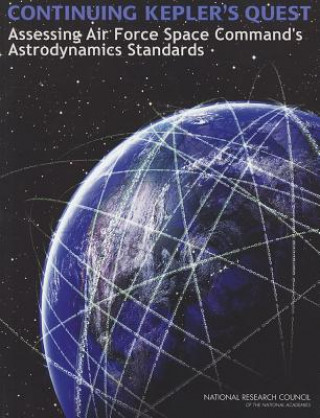
Carte Continuing Kepler's Quest Committee for the Assessment of the U.S. Air Force's Astrodynamic Standards

Continuing Kepler's Quest

Assessing Air Force Space Command's Astrodynamics Standards

Limbă: engleză
Legare: Carte broșată
Disponibilitate: șansă 50%
Şanse de a obține acest titlu
240.07 lei
In February 2009, the commercial communications satellite Iridium 33 collided with the Russian milit...
Informații despre carte

Limbă
engleză
Legare
Carte - Carte broșată
Publicat
2012
Pagini
82
EAN
9780309261425
ISBN
0309261422
Enbook ID
04579403
Greutate
318
Dimensiuni
216 x 279 x 8

Descriere completă

In February 2009, the commercial communications satellite Iridium 33 collided with the Russian military communications satellite Cosmos 2251. The collision, which was not the first recorded between two satellites in orbit--but the most recent and alarming--produced thousands of pieces of debris, only a small percentage of which could be tracked by sensors located around the world. In early 2007, China tested a kinetic anti-satellite weapon against one of its own satellites, which also generated substantial amounts of space debris. These collisions highlighted the importance of maintaining accurate knowledge, and the associated uncertainty, of the orbit of each object in space. These data are needed to predict close approaches of space objects and to compute the probability of collision so that owners/operators can decide whether or not to make a collision avoidance maneuver by a spacecraft with such capability. The space object catalog currently contains more than 20,000 objects, and when the planned space fence radar becomes operational this number is expected to exceed 100,000. A key task is to determine if objects might come closer to each other, an event known as "conjunction," and the probability that they might collide. The U.S. Air Force is the primary U.S. government organization tasked with maintaining the space object catalog and data on all space objects. This is a complicated task, involving collecting data from a multitude of different sensors-many of which were not specifically designed to track orbiting objects-and fusing the tracking data along with other data, such as data from atmospheric models, to provide predictions of where objects will be in the future. The Committee for the Assessment of the U.S. Air Force's Astrodynamic Standards collected data and heard from numerous people involved in developing and maintaining the current astrodynamics standards for the Air Force Space Command (AFSPC), as well as representatives of the user community, such as NASA and commercial satellite owners and operators. Preventing collisions of space objects, regardless of their ownership, is in the national security interested of the United States. Continuing Kepler's Quest makes recommendations to the AFSPC in order for it to create and expand research programs, design and develop hardware and software, as well as determine which organizations to work with to achieve its goals.

S-ar putea să te intereseze

GSD 08 Platform

Llu's Ortega
105.26 lei
483.28 lei

Message Delayed

Edward Tudor
140.25 lei
102.74 lei
45.70 lei
87.77 lei

Boobs

Ruth Daniell
106.17 lei
70.07 lei

CHUCKLERS

Jeff Brackett
79.17 lei

Heat

Pasquale Buba
65.52 lei

Prisionero del Cielo

Carlos Ruiz Zafon
77.25 lei
79.37 lei

A Certain Plume

Henri Michaux
82.71 lei

Carmilla

Joseph Sheridan Le Fanu
35.99 lei

Spirit of Music

Victor L. Wooten
81.50 lei

Garden of Words

Makoto Shinkai
85.44 lei

Tiny Habits

Brian Jeffrey Fogg
70.98 lei
74.93 lei
77.46 lei
25.07 lei

Clienții care au cumpărat această carte au mai cumpărat și

971.02 lei

Adaptujte se

Tim Harford
66.93 lei
157.55 lei
162.81 lei

Josiane

Jo Lopes
38.52 lei
41.65 lei
75.43 lei