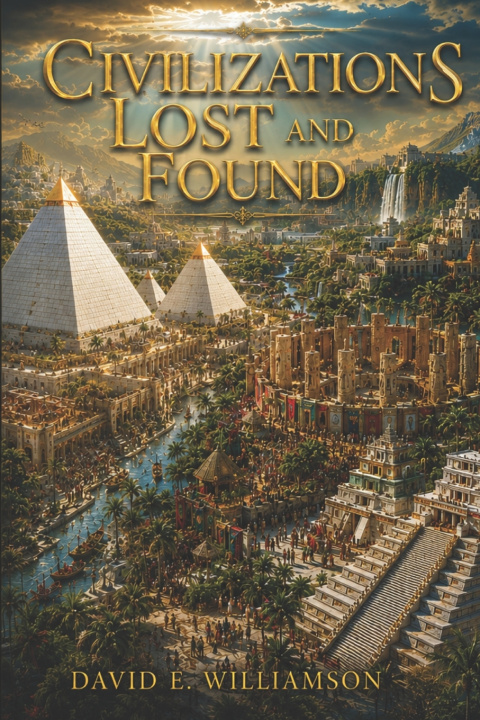
Something is wrong with the standard story of human history.
The Great Pyramid encodes mathematical constants that dynastic Egypt shows no evidence of knowing. Göbekli Tepe was built before pottery, the wheel, or agriculture were supposed to exist. Frozen mammoths still contain subtropical vegetation in their stomachs. More than two hundred independent flood narratives exist on every inhabited continent, in cultures with no known contact, all telling the same story.
Mainstream archaeology calls these anomalies. Graham Hancock calls them evidence of a lost pre-Ice Age civilization. The History Channel calls them the work of ancient aliens.
The Bible calls them the ruins of the world before Noah's Flood.
In Civilizations Lost, and Found, David E. Williamson makes the case that the lost civilization everyone is searching for has been hiding in plain sight for three thousand years, described in the first seven chapters of Genesis, and dismissed by a scientific establishment whose foundational assumptions were built not on evidence but on a deliberate nineteenth-century decision to make God unnecessary.
What Genesis actually describes, taken seriously as history, is a planetary civilization of potentially ten billion long-lived human beings, accumulating knowledge across sixteen centuries, building at a scale and precision that four thousand years of subsequent civilization has never replicated, destroyed in a single catastrophic year when the fountains of the great deep burst open and the world before Noah went under the water.
The ruins of that world are everywhere: buried under ancient tells, submerged beneath continental shelves, frozen into arctic permafrost, and encoded in the memory of every culture that has ever told the story of a great flood that ended the world and left only a handful of survivors to begin again.
This book traces that evidence across fifteen chapters, drawing on catastrophist geology, Hebrew etymology, population mathematics, vertebrate physiology, and the prophetic parallel between the days of Noah and the generation alive right now. It also does something most apologetics books never attempt: it names exactly what evidence would falsify its own model, and explains why none of it has materialized.
The greatest lost civilization is not waiting to be discovered.
It is waiting to be remembered.
And the God who judged it is not done speaking through its ruins.