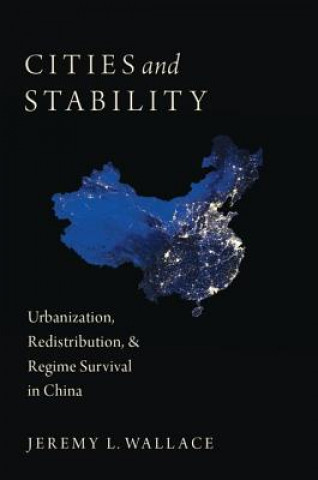
Carte Cities and Stability Jeremy Wallace

Cities and Stability

Urbanization, Redistribution, and Regime Survival in China

Limbă: engleză
Legare: Copertă tare
Disponibilitate: În depozitul extern
Expediem în 10-18 zile
769.87 lei
Cities bring together masses of people, allow them to communicate and hide, and to transform private...

Informații despre carte

Limbă
engleză
Legare
Carte - Copertă tare
Publicat
2014
Pagini
266
EAN
9780199378982
ISBN
0199378983
Enbook ID
04532402
Greutate
512
Dimensiuni
163 x 237 x 18

Descriere completă

Cities bring together masses of people, allow them to communicate and hide, and to transform private grievances into political causes, often erupting in urban protests that can destroy regimes. The Chinese Communist Party (CCP) has shaped urbanization via migration restrictions and redistributive policy since 1949 in ways that help account for the regime's endurance, China's surprising comparative lack of slums, and its curious moves away from urban bias over the past decade. Cities and Stability details the threats that cities pose for authoritarian regimes, regime responses to those threats, and how those responses can backfire by exacerbating the growth of slums and cities. Cross-national analyses of nondemocratic regime survival link larger cities to shorter regimes. To compensate for the threat urban threat, many regimes, including the CCP, favor cities in their policy-making. Cities and Stability shows this urban bias to be a Faustian Bargain, stabilizing large cities today but encouraging their growth and concentration over time. While attempting to industrialize, the Chinese regime created a household registration (hukou) system to restrict internal movement, separating urban and rural areas. China's hukou system served as a loophole, allowing urbanites to be favored but keeping farmers in the countryside. As these barriers eroded with economic reforms, the regime began to replace repression-based restrictions with economic incentives to avoid slums by improving economic opportunities in the interior and the countryside. Yet during the global Great Recession of 2008-09, the political value of the hukou system emerged as migrant workers, by the tens of millions, left coastal cities and dispersed across China's interior villages, counties, and cities. The government's stimulus policies, a combination of urban loans for immediate relief and long-term infrastructure aimed at the interior, reduced discontent to manageable levels and locales.

S-ar putea să te intereseze

The Soul of a Chef

Michael Ruhlman
81.50 lei

Auriculotherapy

Graham Julian Oliver
55.41 lei

Sleep No More

Amanda Quick
58.75 lei
814.77 lei
108.20 lei
74.52 lei

Heart of Naosaqua

Katherine Von Ahnen
51.97 lei

Kundalini

Lilian Silburn
192.64 lei

Clienții care au cumpărat această carte au mai cumpărat și

Limite del 7% a Los Donativos

Héctor Torres Solís
236.02 lei
2 681.49 lei
181.51 lei

Öfen und Kamine

Michael Herrmann
314.60 lei

Carlo Scarpa Venezia

Luciano Pollifrone
164.42 lei