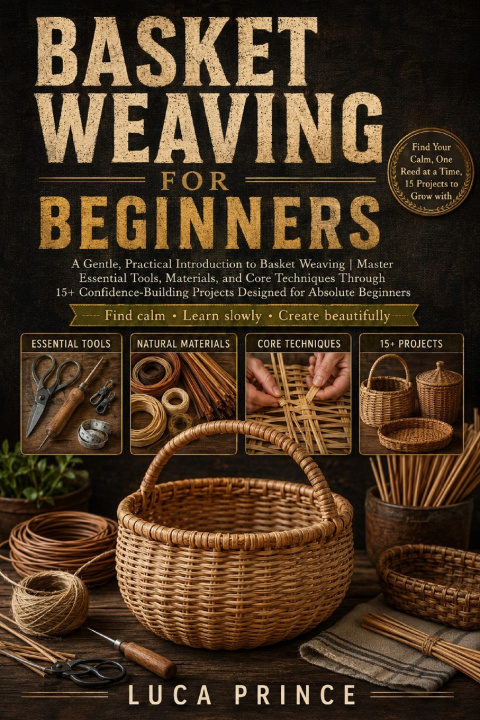
There's something about working with your hands that the rest of life can't touch.
The rhythm of reed passing over reed. The quiet focus required to keep tension even. The way a pile of simple materials, soaking, waiting, pliable, becomes something structured, something useful, something beautiful. Basket weaving has existed for thousands of years, across every culture, for good reason. It calms the mind while engaging the hands. It produces something real while asking nothing more than patience and presence.
But if you've looked into learning, you may have noticed something: most books assume you already know things. They use words like "spokes" and "slath" and "upsett" without explanation. They show finished baskets and assume you'll figure out the steps between. They teach techniques without teaching the feeling of when a technique is working, that quiet knowing that only comes from someone describing not just what to do, but what it should feel like while you're doing it.
This book takes a different path entirely.
A Personal Note from Someone Who Learned Slowly
I came to basket weaving at a time when I needed to slow down. My first basket took three tries. The base twisted. The sides leaned. The handle never quite matched what I'd imagined. But somewhere in that imperfect process, something shifted. I stopped caring about the finished product and started caring about the feeling of weaving itself.
That shift changed everything. Not just my baskets, my relationship with making.
This book isn't about perfection. It's about presence. It's about learning at a pace that lets the knowledge settle into your hands, not just your head. The projects will teach you technique. The process will teach you everything else.
What You'll Walk Away With
Not just finished baskets, though you'll have fifteen of those. Not just technique, though you'll understand this craft differently than most beginners.
You'll walk away with:
- The ability to look at any basket and understand how it was made
- The confidence to modify patterns to suit your style
- The knowledge to fix mistakes without frustration
- The vocabulary to combine techniques intentionally
- The quiet satisfaction of creating something useful and beautiful with your hands
And perhaps most valuable: a practice that asks nothing but your presence, and gives back something that can't be rushed.Before You Decide
If you're looking for a book of beautiful photos to inspire you, there are many to choose from.
If you're looking for someone to sit beside you as you learn, to explain not just what to do, but what it should feel like while you're doing it, then this is exactly what you've been searching for.
Your first reed is waiting. Your hands know what to do. Let's begin slowly, together.There's something about working with your hands that the rest of life can't touch.The rhythm of reed passing over reed. The quiet focus required to keep tension even. The way a pile of simple materials, soaking, waiting, pliable, becomes something structured, something useful, something beautiful. Basket weaving has existed for thousands of years, across every culture, for good reason. It calms the mind while engaging the hands. It produces something real while asking nothing more than patience and presence.
But if you've looked into learning, you may have noticed something: most books assume you already know things. They use words like "spokes" and "slath" and "upsett" without explanation. They show finished baskets and assume you'll figure out the steps between. They teach techniques without teaching the
feeling of when a technique is working, that quiet knowing that only comes from someone describing not just what to do, but what it should feel like while you're doing it.
This book takes a different path entirely.