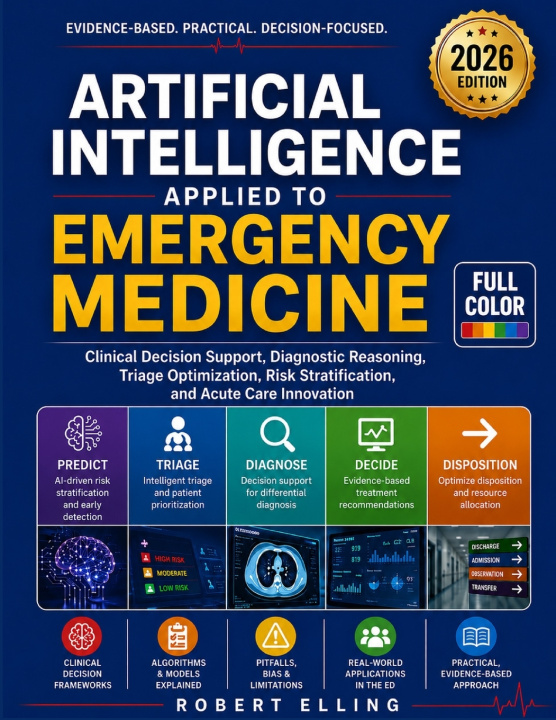
Emergency medicine demands clear judgment, rapid prioritization, and reliable decisions under pressure. As artificial intelligence becomes increasingly integrated into acute care, clinicians and healthcare leaders need a practical framework for using these tools safely, thoughtfully, and effectively at the bedside.
Artificial Intelligence Applied to Emergency Medicine provides a clinically rigorous guide to understanding how AI can support triage, diagnostic reasoning, risk stratification, treatment decisions, documentation, patient flow, and emergency department operations. Written with a strong focus on safety, validation, bias, local protocols, and human oversight, the book shows how AI can strengthen clinical practice while preserving clinician accountability and patient-centered judgment.
Readers move from foundational AI concepts to real-world emergency medicine applications, learning how to interpret model outputs, evaluate clinical tools, recognize failure modes, integrate decision support into workflow, and maintain safe boundaries in high-risk acute care environments. The result is a practical and measured understanding of how AI can become a dependable clinical support layer across the emergency care pathway.
Inside, you'll learn how to:
• Apply AI-supported clinical reasoning across triage, diagnosis, imaging, laboratory interpretation, medication safety, treatment planning, and disposition decisions.
• Evaluate AI tools before implementation by assessing evidence, local validation, workflow fit, bias, privacy, governance, and patient-safety risk.
• Use generative AI responsibly for clinical documentation, discharge instructions, handoffs, consultations, and transfer summaries.
• Recognize red flags and failure modes while maintaining human oversight, clear documentation, and clinician-led decision-making.
Designed for emergency physicians, residents, advanced practice clinicians, nurses, informatics professionals, department leaders, and healthcare administrators, this book offers a practical reference for navigating AI-supported acute care with confidence, discipline, and clinical responsibility.
Build a safer, more informed, and more effective approach to artificial intelligence in emergency medicine-while keeping patient context and clinical judgment at the center of every decision.