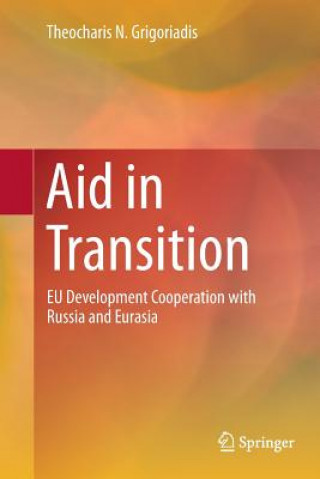
Carte Aid in Transition Theocharis N. Grigoriadis

Aid in Transition

EU Development Cooperation with Russia and Eurasia

Limbă: engleză
Legare: Carte broșată
Disponibilitate: În depozitul extern în cantități mici
Expediem în 13-18 zile
296.60 lei
This book is the one of the first to address aid effectiveness as a political and comparative econom...


Informații despre carte

Limbă
engleză
Legare
Carte - Carte broșată
Publicat
2016
Pagini
103
EAN
9781493944538
ISBN
1493944533
Enbook ID
13786294
Greutate
1942
Dimensiuni
155 x 235 x 6

Descriere completă

This book is the one of the first to address aid effectiveness as a political and comparative economics question. Since the collapse of the Soviet Union and the transition of its republics to market structures and more representative forms of government, the European Commission has recognized the necessity of a closer economic cooperation with Russia, Ukraine and Kazakhstan, the three largest economies of the former Soviet Union. This book suggests that the foreign aid of the European Union provided a set of reform incentives to post-Soviet planners. It created the grounds for the institutional and social transformation of the bureaucracy at both central and regional levels by integrating it into the aid allocation process. In Russia, Ukraine and Kazakhstan, the observed subordination of NGOs to the developmental priorities of the bureaucracy occurred at the expense of diversity and political openness. Nevertheless, this reality led to the emergence of transnational sovereignty partnerships that reduced poverty for the general population and motivated both bureaucrats and entrepreneurs to cooperate. Empirical models alone are not sufficient to delineate all the aspects of principal-agent relationships in post-Soviet bureaucracies. This is why formal modeling and analysis of qualitative data are extremely useful. Evaluation reports indicate the problems and challenges faced by aid bureaucrats and suggest that the weakly institutionalized environments of Ukraine and Central Asia/Kazakhstan are less conducive to aid effectiveness than the heavily bureaucratized environment of Russia. The proposed incentives system for the allocation of foreign aid links EU foreign policy with bureaucratic decision-making and reflects the choice sets of the donor and the recipient. Multilevel definitions of aid effectiveness are provided in the course of the book chapters.

S-ar putea să te intereseze

225.94 lei
299.52 lei

Processed for Purpose

Gail Burks-Stansell
49.21 lei
119.26 lei
59.77 lei
1 264.52 lei

No-Good Nine

John Bemelmans Marciano
46.69 lei

Clienții care au cumpărat această carte au mai cumpărat și

134.55 lei

Dino

Sofia Daniela Avilan Carrero
85.74 lei

Mandala

Joyful Time
46.29 lei
57.66 lei
51.12 lei
154.48 lei