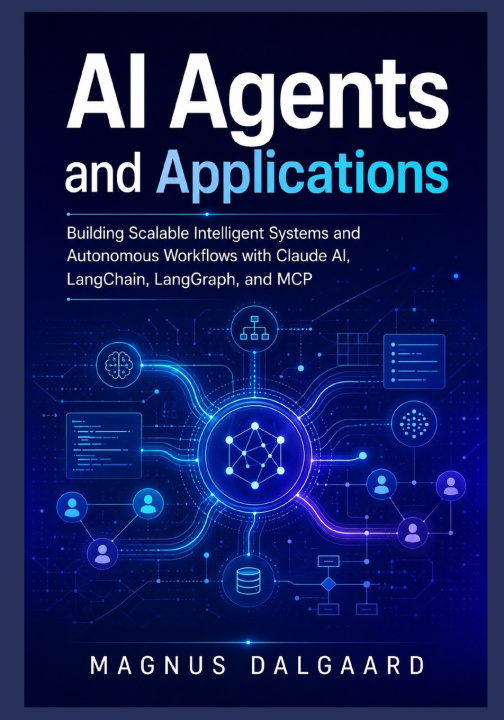
The emergence of autonomous AI agents represents a fundamental paradigm shift in artificial intelligence, transforming large language models from reactive tools into proactive, goal-oriented systems capable of planning, reasoning, collaborating, and executing complex multi-step workflows with minimal human oversight.
AI Agents and Applications provides a comprehensive, production-focused guide to designing, implementing, and scaling these intelligent systems using the most powerful tools available today: Anthropic's Claude AI, LangChain, LangGraph, and the Multi-Agent Communication Protocol (MCP).
This book equips experienced AI engineers, software architects, and technical leaders with the frameworks, patterns, and methodologies required to move beyond simple LLM chains into robust, enterprise-grade agentic architectures. Readers will develop deep expertise in leveraging Claude AI's constitutional safeguards, superior long-context reasoning, and reliable tool-calling capabilities to build trustworthy agents.
They will master LangChain's composable abstractions for memory, retrieval, and tool integration while learning to construct sophisticated, stateful workflows using LangGraph's graph-based orchestration model. The Multi-Agent Communication Protocol (MCP) is presented as the critical coordination layer that enables secure, context-aware message passing, shared memory, and collaborative intelligence across distributed agent networks.
Progressing logically from foundational principles to advanced implementation, the content covers goal decomposition, persistent memory architectures, human-in-the-loop design patterns, self-reflective improvement loops, multi-agent debate and consensus mechanisms, and advanced retrieval-augmented generation systems. Production chapters address containerization, Kubernetes orchestration, observability, distributed tracing, security hardening, cost optimization, and CI/CD pipelines specifically tailored for long-running autonomous systems.
Real-world case studies demonstrate applications in enterprise automation, scientific research acceleration, creative content pipelines, financial analysis, and regulated healthcare environments, highlighting both technical approaches and organizational adoption strategies.
Written for professionals who already understand Python, APIs, and LLM fundamentals, this book delivers actionable code patterns, architectural blueprints, and strategic frameworks rather than superficial overviews. It emphasizes maintainability, extensibility, governance, and measurable business impact, ensuring that the intelligent systems you build are not only powerful but also reliable, secure, and scalable.
Whether your objective is to automate intricate business processes, accelerate research and discovery, or deliver next-generation AI products, this definitive technical resource provides the depth and clarity required to succeed. Begin building production-ready autonomous agent systems today.