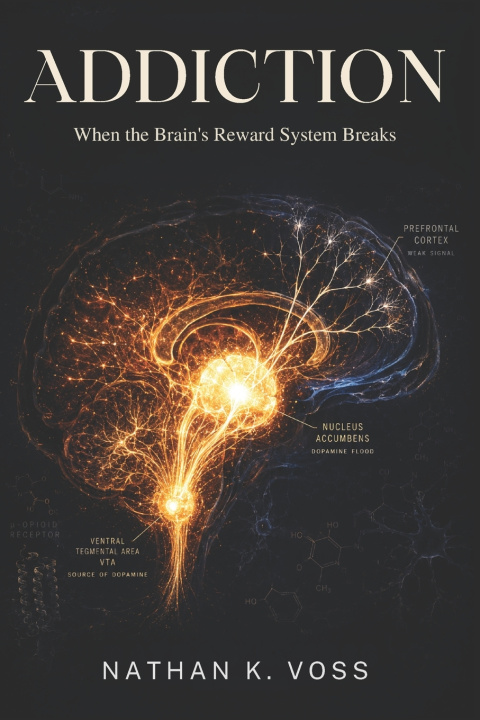
Carte Addiction Nathan K. Voss

Addiction

When the Brain's Reward System Breaks

Limbă: engleză
Legare: Carte broșată
Disponibilitate: Așteptăm intrarea în stoc
Ediția 05. 06. 2026
81.30 lei
It is not a moral failing. It is not a lack of willpower. It is what happens when the brain's most p...

Informații despre carte

Limbă
engleză
Legare
Carte - Carte broșată
Publicat
2026
Pagini
106
EAN
9798199365192
Enbook ID
52750362
Greutate
141
Dimensiuni
152 x 229 x 7

Descriere completă

It is not a moral failing. It is not a lack of willpower. It is what happens when the brain's most powerful learning system is hijacked by the most potent stimulus it has ever encountered.

Every year, addiction kills millions of people - through overdose, through the diseases it causes, through the accidents and suicides it facilitates. It destroys families, careers, and communities on a scale that makes it one of the largest public health emergencies in the world. And for most of recorded history, the response to it has been shaped not by science but by shame - by the conviction that addiction is a choice, and that the appropriate response to bad choices is punishment.

The neuroscience says otherwise.

In this urgent, evidence-based account - the fifth and final book in The Neuroscience Series - Nathan K. Voss draws on five decades of reward neuroscience to explain precisely what addiction is, how it develops, why it is so difficult to stop, and what the science has established about how it can be overcome.

Spanning ten chapters across four parts, this book covers:

  • Dopamine - not the pleasure chemical of popular myth but the brain's prediction and learning signal, and why drugs that flood it with artificial teaching signals produce the most powerful and most durable learning the reward circuit has ever performed
  • The learning machine - how classical conditioning, instrumental conditioning, and habit formation together transform voluntary drug use into compulsive addiction, and why the transition is neurobiological rather than moral
  • Wanting without liking - the dissociation between the brain's motivation system and its pleasure system that drives the impossible experience of craving something you know will not satisfy you
  • Opioids, stimulants, and alcohol - what each class of drug does to the specific circuits it targets, why their withdrawals differ so dramatically in character and in danger, and what the evidence-based treatments for each actually involve
  • Behavioural addictions - gambling, gaming, and the algorithmic exploitation of reward circuits that makes the most addictive products in history available on every smartphone
  • The biology of recovery - what heals in the brain with sustained abstinence, what does not heal easily, and why the first months of recovery are neurobiologically the hardest
  • Treatment - what the evidence actually shows works, why fewer than twenty percent of people who need medication-assisted treatment receive it, and what the structural barriers are that prevent adequate care from reaching the people who need it most

Behind every statistic in this book is a person whose brain was changed by circumstances that the moral model has never adequately accounted for - and that the neuroscience has finally begun to describe with the precision that an effective response requires.

Not punishment. Not shame. Treatment. Compassion. The recognition that the brain caught in addiction is the same brain that, with the right support, can find its way back out.