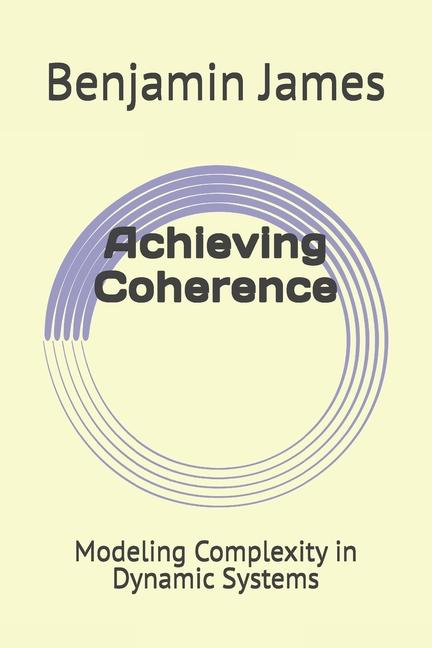
Achieving Coherence offers a new way to understand and work with the complexity that defines our time. In a world shaped by uncertainty and deep interconnection, the SPARC framework, short for Spectrum of Possibility and Recursive Choice, provides a practical model for bridging insight and action across fields. The book explores how systems sustain stability and adapt under changing conditions through the principles of coherence, constraint satisfaction, and recursive feedback. By examining how dimensional shifts, layered constraints, and resilience emerge from dynamic interaction, SPARC reveals how structure and flexibility coexist within evolving environments.
Its ideas apply across a wide range of contexts, from strengthening critical infrastructure and managing ecological systems to improving artificial intelligence and coordinating multi-agent networks. By showing how local choices ripple through larger systems and how adaptation depends on the balance between order and variation, Achieving Coherence offers a clear and forward-looking approach to navigating complexity and designing systems that can grow, learn, and endure.
This work explores the principles of coherence, constraint satisfaction, and recursive feedback, shedding light on how systems maintain stability and adapt in the face of evolving constraints and environmental noise. By integrating dimensional transitions, multi-constraint optimization, and resilience to stochastic influences, SPARC provides a novel approach to modeling systems that are inherently complex and interdependent.
Applications range from stabilizing critical infrastructure and managing ecosystems under stress to advancing artificial intelligence and optimizing multi-agent systems. By demonstrating how local behaviors interact with global dynamics and how systems can thrive under variability, Achieving Coherence presents a compelling vision for navigating complexity and driving innovation in an interconnected world.