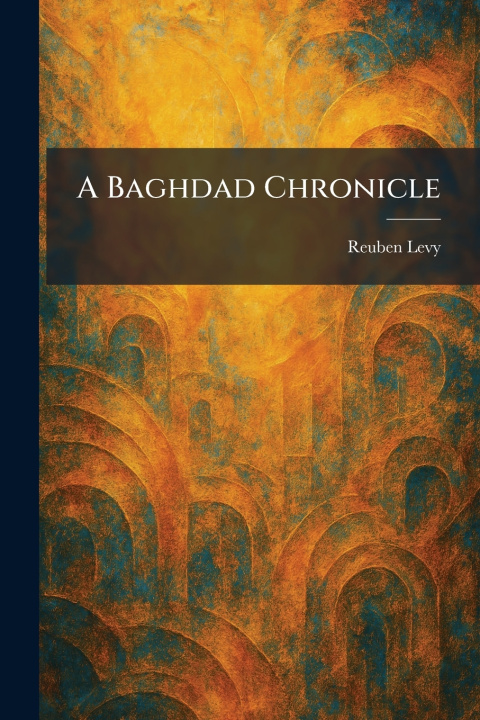
"A Baghdad Chronicle" provides a comprehensive historical account of one of the world's most influential cities during its most formative periods. This work traces the social and political evolution of Baghdad from its founding under the Abbasid Caliphate through its rise as the intellectual and cultural epicenter of the Islamic world. The narrative captures the grandeur of the caliphs, the intricate details of daily life, and the city's unique position as a bridge between East and West.
Through meticulous research, Reuben Levy explores the administrative structures, religious shifts, and the flourishing of arts and sciences that defined the Golden Age. The book examines the city's architectural triumphs, its turbulent periods of siege and conflict, and the diverse population that contributed to its vibrant atmosphere. "A Baghdad Chronicle" serves as an essential resource for those interested in Middle Eastern history, Islamic civilization, and the enduring legacy of a city that shaped the course of human history. This scholarly yet accessible chronicle offers a window into the splendor and the struggles of a metropolis that stood at the heart of an empire.
This work has been selected by scholars as being culturally important, and is part of the knowledge base of civilization as we know it. This work was reproduced from the original artifact, and remains as true to the original work as possible. Therefore, you may see the original copyright references, library stamps (as most of these works have been housed in our most important libraries around the world), and other notations in the work.
This work is in the public domain in the United States of America, and possibly other nations. Within the United States, you may freely copy and distribute this work, as no entity (individual or corporate) has a copyright on the body of the work.
As a reproduction of a historical artifact, this work may contain missing or blurred pages, poor pictures, errant marks, etc. Scholars believe, and we concur, that this work is important enough to be preserved, reproduced, and made generally available to the public. We appreciate your support of the preservation process, and thank you for being an important part of keeping this knowledge alive and relevant.